The First Photograph Ever Taken: The World’s Oldest Photo
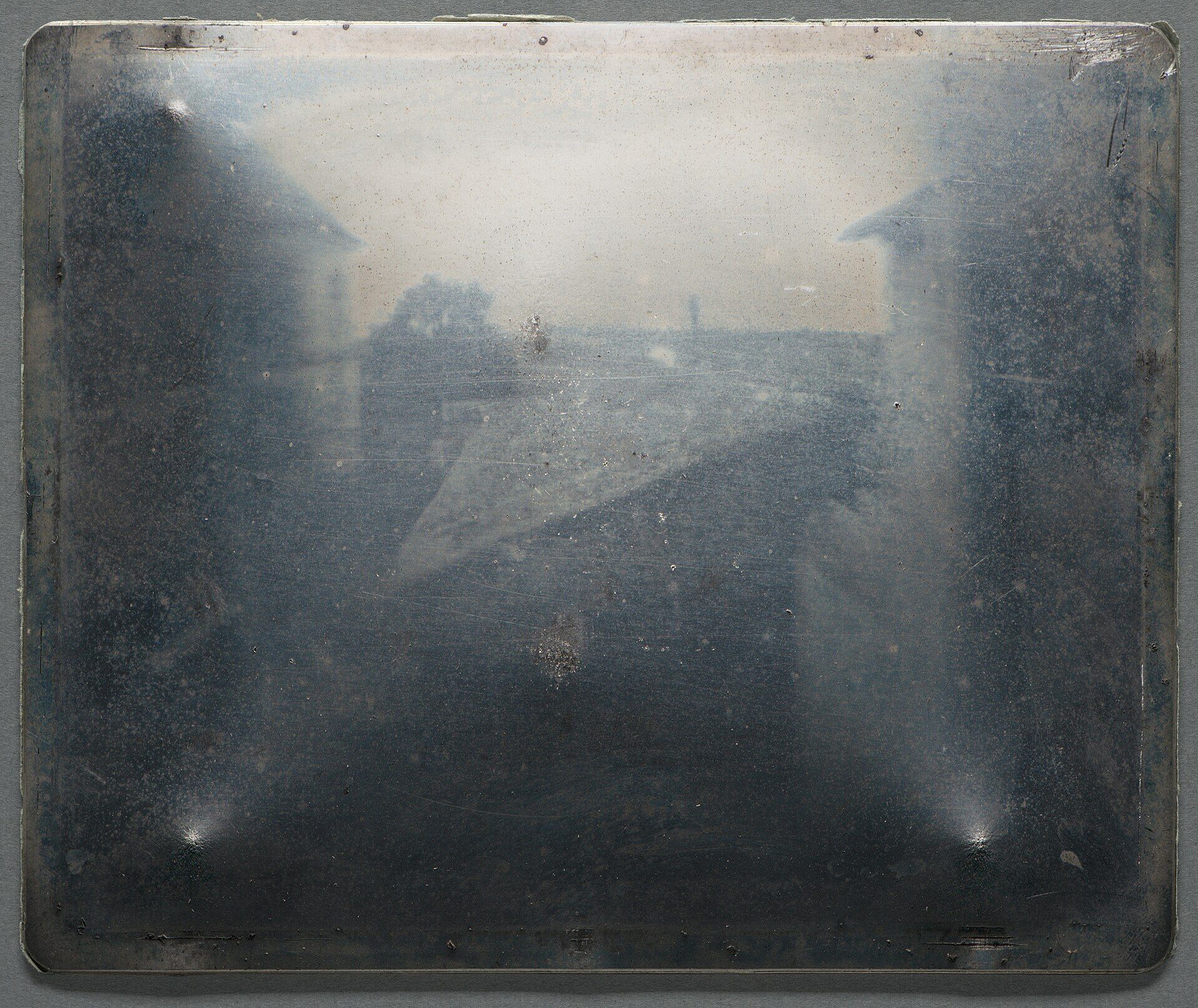
The first surviving photograph made with a camera is Joseph Nicéphore Niépce’s View from the Window at Le Gras, created at his estate in France in 1826 or 1827. It was a landscape. Out of everything a camera could have recorded first, history handed the honor to a view from an upstairs window: rooftops, outbuildings, and a slice of countryside holding still in the summer light. After two decades of pointing cameras at landscapes for a living, I find that fact endlessly satisfying.
This is the story of that image, the man who made it, and the string of firsts that followed: the first person ever photographed, the first intentional portrait, the first photographs made in America, the first color photograph, and the first picture of Earth from space. Fair warning: a couple of the famous details, including the eight-hour exposure everybody quotes, turn out to be shakier than the legend.
Photography Firsts at a Glance
| Milestone | Date | Person | Photograph or Event |
|---|---|---|---|
| First surviving camera photograph | 1826 or 1827 | Joseph Nicéphore Niépce | View from the Window at Le Gras |
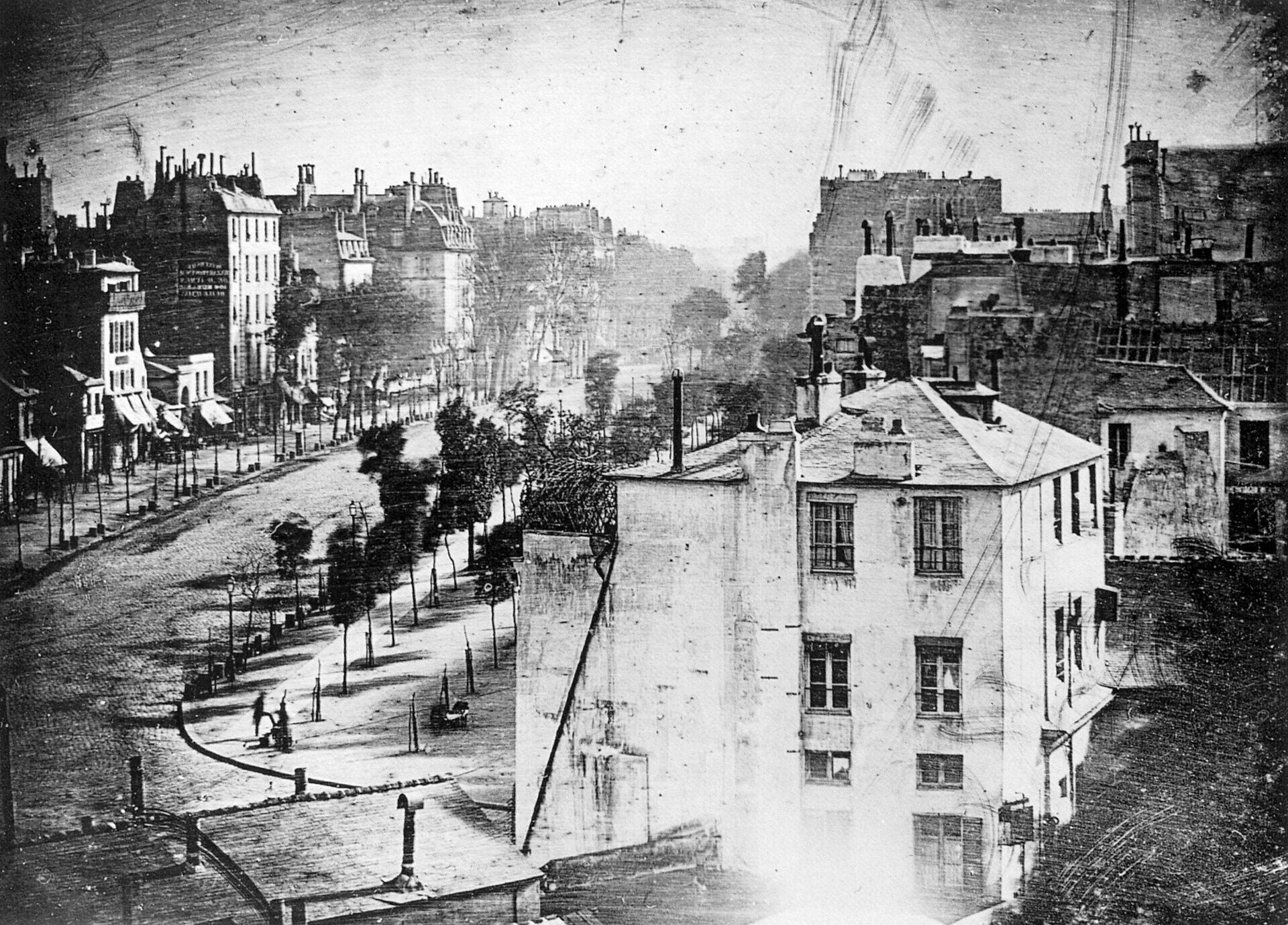
| First person recorded in a photograph | 1838 | Louis Daguerre | Boulevard du Temple |
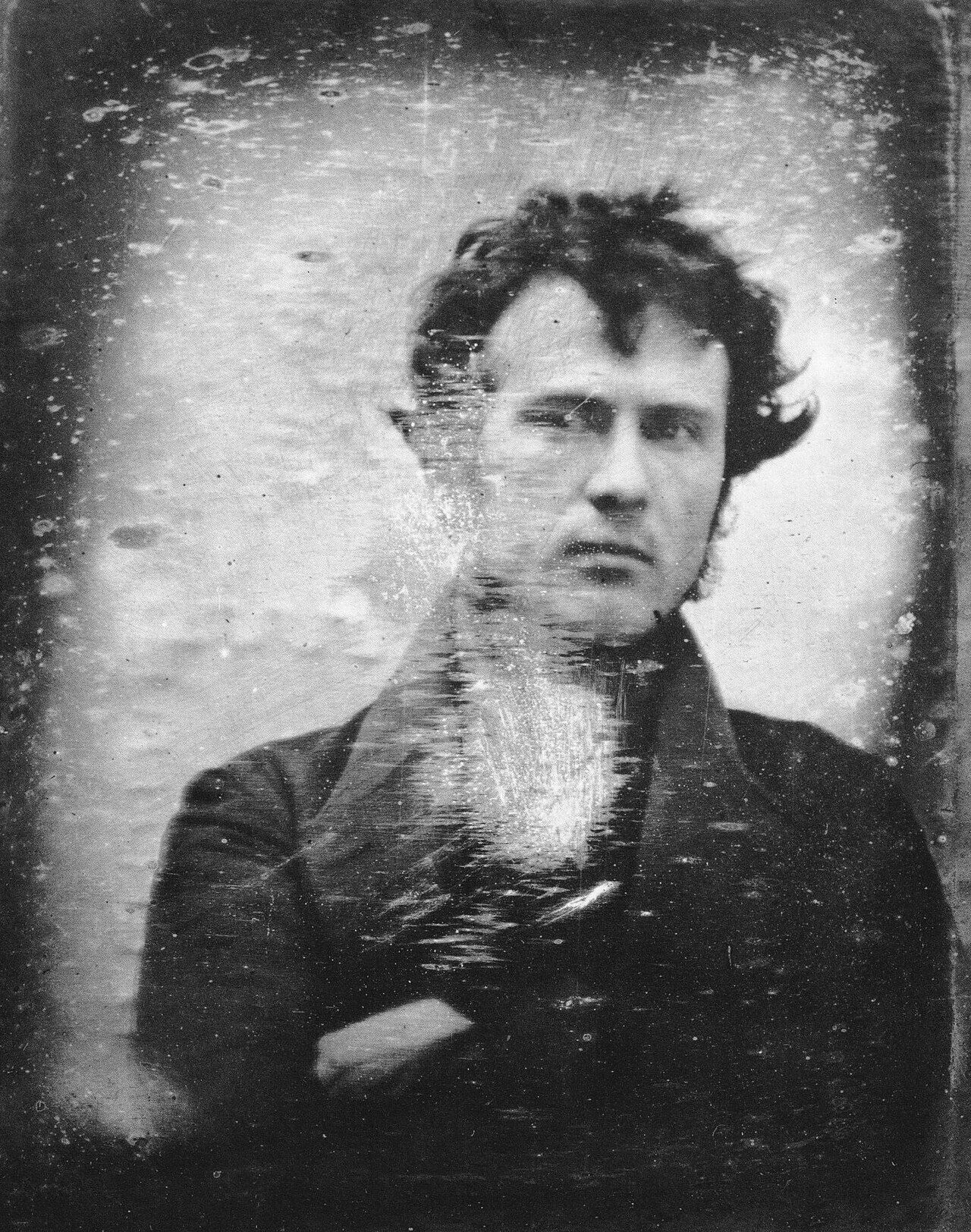
| Earliest surviving intentional photographic portrait | 1839 | Robert Cornelius | Cornelius self-portrait |
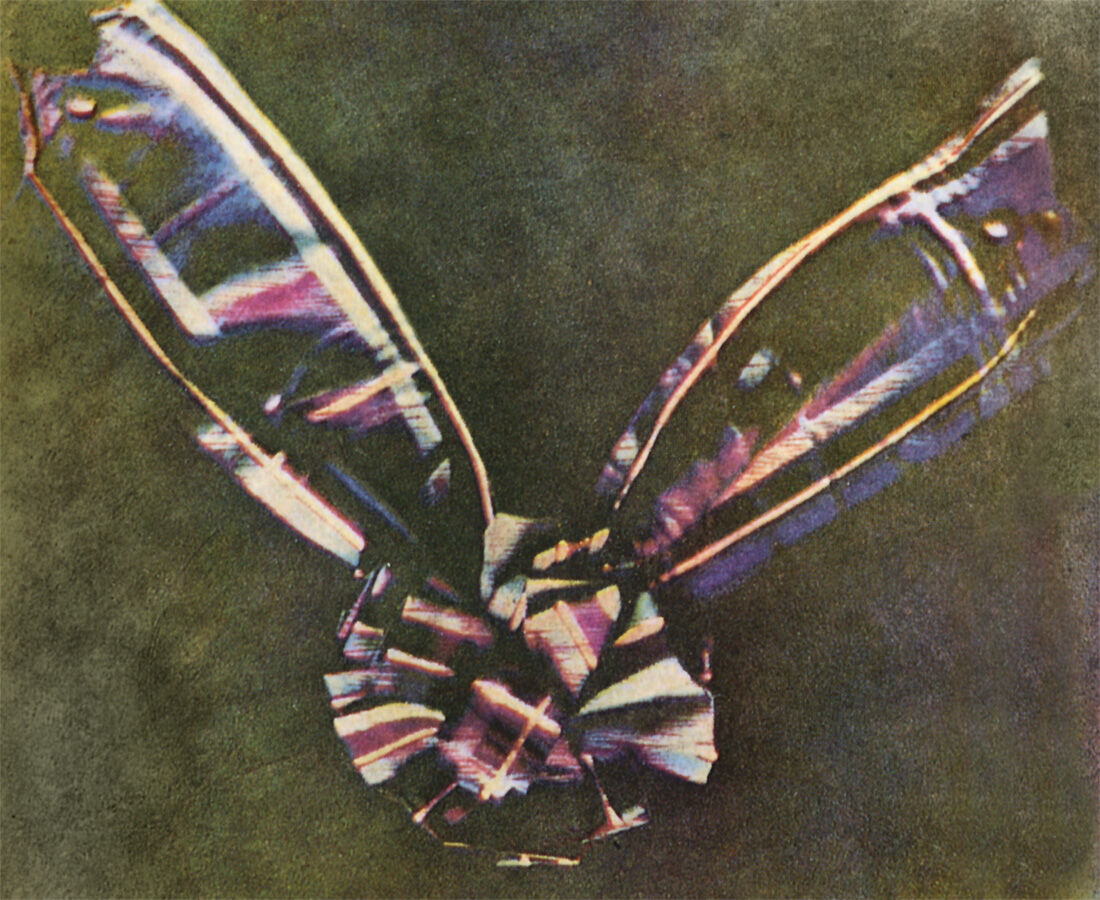
| First widely recognized successful color-photography demonstration | 1861 | James Clerk Maxwell and Thomas Sutton | Tartan ribbon image |
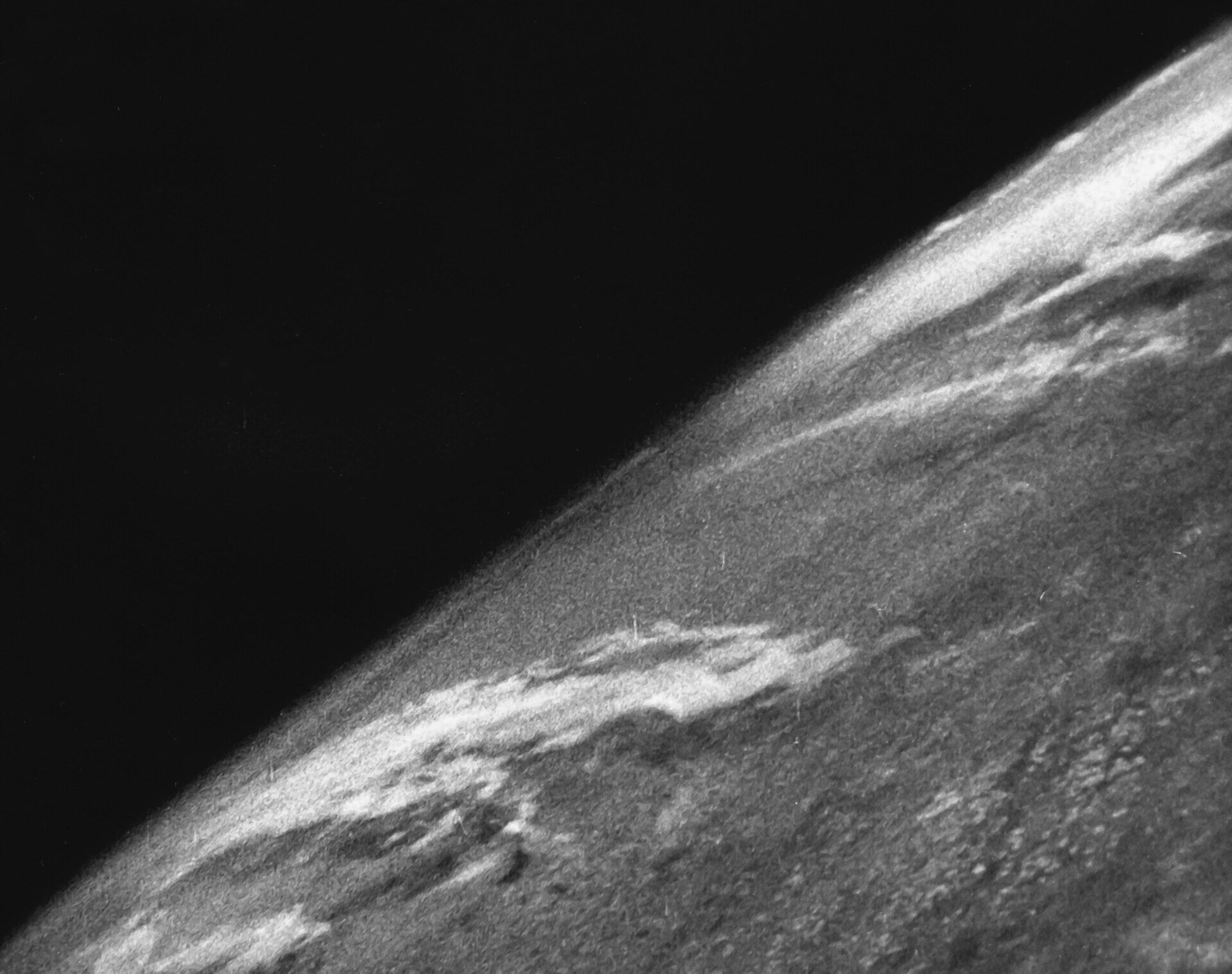
| First photograph of Earth from space | 1946 | V-2 camera experiment | Earth photographed above White Sands, New Mexico |
The First Photograph Ever Taken: View from the Window at Le Gras
The oldest surviving camera photograph in the world is a pewter plate about six and a half by eight inches, made by Joseph Nicéphore Niépce at his country estate, Le Gras, in the village of Saint-Loup-de-Varennes, France. He set a camera obscura at an upstairs window and aimed it at what he could see: the roofline of his own buildings, a courtyard, and the countryside beyond. Historians long dated the plate to 1826, and you’ll still see that year everywhere. Later research pushed the date to 1827, and most institutions now place the exposure in the summer of that year. Either way, the image is approaching its two hundredth birthday.
The plate itself has had a stranger life than most artworks. Niépce carried it to England in 1827, where the Royal Society declined to hear his paper because he refused to reveal how the process worked. He left the plate with a botanical illustrator named Francis Bauer and went home. It passed through private hands, dropped out of sight, and stayed lost until 1952, when the photo historians Helmut and Alison Gernsheim tracked it down. In 1963 it crossed the Atlantic to the Harry Ransom Center at the University of Texas at Austin, where it sits today in a sealed case filled with inert gas, on public display. Anyone can walk in and stand in front of the first photograph. If you ever get the chance, take it. Time in front of original objects is how you build judgment, something I’ve written about in developing a collector’s eye in museums.
How the First Photograph Was Made
The first photograph was made on a polished pewter plate coated with bitumen of Judea, a naturally occurring asphalt. Niépce called the process heliography—sun writing—and the name is accurate. The bitumen hardened where light struck it during the exposure. Afterward, a wash containing lavender oil dissolved the unhardened material in the shadow areas, leaving behind a faint but permanent image: light drawn by light.
Here’s where the legend wobbles. The famous answer is that the exposure took eight hours, an estimate based on the odd fact that sunlight appears to strike buildings on opposite sides of the scene, as if the sun had crossed the whole sky during the exposure. But a modern researcher who studied Niépce’s notes and recreated his process concluded the plate must have sat exposed for several days. Days. Every landscape photographer who has ever grumbled about waiting twenty minutes for the light to come good should sit with that for a moment. Photography’s first exposure setting was measured on a calendar.
Who Created the First Photograph?
Nicéphore Niépce was a gentleman inventor of the old style. Before photography, he and his brother built one of the world’s first internal combustion engines. His route to the camera ran through lithography and a stubborn question: could light be made to draw an image directly, without a human hand? The plate at his window answered it.
The sad turn is that he never saw what he’d started. In 1829 Niépce entered a partnership with Louis Daguerre, a Paris showman and painter chasing the same problem. Niépce died in 1833. Daguerre kept working, and the process that finally made photography practical would carry Daguerre’s name, not his. History has been correcting the ledger ever since.
When Was Photography Invented?
The honest answer has two dates, and which one you use depends on what you mean by invented.
If you mean the first surviving photograph, the answer is 1826 or 1827, at that window in Saint-Loup-de-Varennes. If you mean the moment photography arrived as a working technology the world could use, the answer is 1839. That January, Daguerre’s invention was announced to the French Académie des Sciences, and that August the full process was published. The daguerreotype produced a sharp, detailed image on a silvered copper plate in minutes rather than days, and it spread across the globe with astonishing speed. The same year, in England, William Henry Fox Talbot revealed a rival process on paper that produced a negative from which copies could be printed, the seed of how photography would work for the next century and a half. Even the word photography dates to 1839, usually credited to the astronomer John Herschel.
From there the milestones stack up fast: color experiments beginning in the 1860s, dry plates freeing cameras from the darkroom tent in the 1880s, and in 1888 the first Kodak camera, which turned photography from a chemist’s craft into something anyone could hold. Barely sixty years separate a pewter plate that needed days of sun from a camera in an ordinary coat pocket.
The First Photograph of a Person
In 1838, from a window beside his Paris studio, Daguerre made a plate of the Boulevard du Temple at around eight in the morning. Some scholars argue for 1837. The street below was one of the busiest in the city, crowded with carriages, horses, and foot traffic, yet the photograph shows it almost completely empty. The exposure ran several minutes, and anything that moved simply failed to register. The crowds erased themselves.
Except one man. In the lower left corner, a figure stands with his boot up on a shoeshine stand, holding still just long enough for the plate to catch him. Look closely and you can make out the shoeshiner too. That anonymous Parisian, waiting on a polish, is widely considered the first human being ever photographed. He never knew.
I love this image for a working reason. That erasing effect never went away; we just learned to aim it. Screw a ten-stop filter onto a lens today and you’re doing exactly what the Boulevard du Temple did by accident: stretching time until motion dissolves, turning a crowd into a ghost or a river into silk. It’s one of the oldest tricks in photography because it’s the first one photography ever played.
The First Portrait and the First Photograph in America
Photography crossed the Atlantic almost immediately. In late September 1839, weeks after the daguerreotype process was published, Joseph Saxton made a small plate of Central High School in Philadelphia that’s considered one of the oldest photographs taken in the United States.
A few weeks later came something bolder. Robert Cornelius, a young Philadelphia metalworker with a talent for polishing plates, set up an improvised camera fitted with an opera-glass lens outside his family’s store, took off the lens cap, and stepped into the frame. He held himself still for what accounts describe as anywhere from one minute to fifteen, then covered the lens. The result, an off-center young man with crossed arms and windblown hair, is generally accepted as the earliest surviving intentional photographic portrait, and the first made in America. People like to call it the world’s first selfie, which undersells it. Nobody had ever done what he was attempting, and he did it to his own face, in his own yard, on the first try that survived.
The First Color Photograph
One of photography’s next great milestones came in 1861, when physicist James Clerk Maxwell demonstrated a method for producing a color image using three separate exposures made through red, green, and blue filters. Photographer Thomas Sutton made the exposures of a tartan ribbon, and the resulting image is widely described as the first successful demonstration of color photography.
The process was not yet practical enough to replace black-and-white photography, but the underlying idea was remarkably modern: separate the colors of light and recombine them to recreate the scene. The technology would change enormously, but that basic relationship between red, green, and blue remains fundamental to digital color imaging today.
The First Photograph of Earth
Jump forward a century. On October 24, 1946, a captured German V-2 rocket lifted off from the White Sands Missile Range in New Mexico with a 35 mm motion picture camera bolted into its nose, snapping a frame every second and a half. The rocket climbed to 65 miles, above the accepted edge of space, then fell back and hit the desert floor hard enough to destroy the camera. The film survived inside a steel cassette. On those grainy black-and-white frames, for the first time, the curve of the Earth stood against the blackness of space.
Before that day, the highest photographs ever made came from a balloon at about 14 miles. Twenty-two years later, on Christmas Eve 1968, the crew of Apollo 8 photographed the whole Earth rising over the lunar horizon, and Earthrise became one of the most reproduced landscape photographs ever made. Which is what it is, by the way: a landscape. The subject just happens to be everything.
Why So Many Early Photographs Are One of a Kind
Search the history of photography for long and you’ll keep running into a strange phrase: the only known photograph. The only known photograph of a particular person, a vanished building, an extinct animal. There’s a technical reason the phrase exists. The heliograph on Niépce’s pewter plate is a unique object; there is no negative and there are no copies. Daguerreotypes worked the same way. Each one is a direct positive on a silvered plate, a one-of-one, which is why a daguerreotype lost is an image gone from the world forever. Talbot’s negative changed the economics of the medium, but those first decades left behind thousands of images that exist exactly once.
I think about that often, because scarcity still gives a photograph its gravity. An image that can’t be endlessly multiplied is a different kind of object from one that can. It’s the same instinct behind limited editions today, and it’s part of how I structure my own work, which I explain in my guide to edition sizes and print materials.
From a Window in France to the American West
Run the thread forward from that upstairs window and it passes through the survey photographers who hauled glass plates and portable darkrooms into the American West, through the tradition I trace in my history of landscape photography, and on through the photographers who defined the national parks. It ends, for now, with anyone standing behind a tripod at dawn.
The gear has changed beyond recognition. The transaction hasn’t. Light comes in, patience goes out, and if you’ve judged both correctly, you carry home a piece of the world. Niépce spent days on his exposure. I’ve spent twenty years on mine, one dawn at a time, and I consider it the same apprenticeship.
Niépce died six years before photography was announced to the world, with no way to know what he’d started. Two centuries later, every photograph on your phone, on your walls, and on this site descends from that one pewter plate. Not bad for a view of some rooftops.
Questions People Ask About the First Photographs
When was the first photograph taken?
The oldest surviving camera photograph was made in 1826 or 1827, and recent scholarship favors the summer of 1827. Joseph Nicéphore Niépce exposed a bitumen-coated pewter plate at an upstairs window of his estate in Saint-Loup-de-Varennes, France. Photography’s public birth came later, in 1839, when the daguerreotype was announced.
What was the first photograph ever taken?
View from the Window at Le Gras, a small pewter plate showing rooftops, outbuildings, and the countryside around Niépce’s estate, recorded from an upstairs window. It’s the earliest surviving camera photograph in the world, and fittingly, it’s a landscape.
Who created the first photograph?
French inventor Joseph Nicéphore Niépce created the earliest surviving camera photograph. He called his process heliography, meaning sun writing. He partnered with Louis Daguerre in 1829 and died in 1833, six years before photography was announced to the world. He never learned what he had started.
What substance was the first photograph made from?
Niépce made View from the Window at Le Gras on a polished pewter plate coated with bitumen of Judea, a naturally occurring asphalt. Light hardened the bitumen during the exposure, and the unhardened material was later dissolved away to reveal the image.
What was the first photograph of a person?
Boulevard du Temple, made by Louis Daguerre in Paris in 1838, contains the earliest widely recognized photographic image of a person. The exposure ran several minutes, so moving crowds vanished, but a man having his boots shined held still long enough to be recorded. The first intentional portrait came in 1839, when Robert Cornelius photographed himself in Philadelphia.
What was the first color photograph?
The first widely recognized successful demonstration of color photography was made in 1861. Physicist James Clerk Maxwell demonstrated the method using three color-filtered exposures photographed by Thomas Sutton, producing the famous image of a tartan ribbon.
Where is the first photograph now?
At the Harry Ransom Center at the University of Texas at Austin. The plate was rediscovered in 1952 by historians Helmut and Alison Gernsheim, arrived in Austin in 1963, and sits on public display in a sealed case filled with inert gas. Anyone can walk in and see it.
When was the first picture of Earth taken?
On October 24, 1946, by a 35 mm motion picture camera riding a V-2 rocket launched from White Sands, New Mexico. The rocket reached 65 miles, the camera was destroyed on landing, and the film survived inside a steel cassette. Apollo 8’s famous Earthrise came 22 years later.