Art Print vs Poster: What's the Difference?
Two images can look identical on your phone. Order one as a poster and it shows up for forty dollars. Order the other as a fine art print and it can run a hundred times that. Same picture, wildly different objects, and the gap confuses almost everyone who asks me about it.
I’ve spent two decades photographing the Pacific Northwest and printing my own editions in-house, so I sit on one side of this divide. But I’ll give it to you straight, because the truth helps both of us. Posters and fine art prints are built for different jobs, and knowing the difference will save you money in one room of your house and regret in another.
What Is the Difference Between an Art Print and a Poster?
The main difference between an art print and a poster is how it is made and what it is made to do. A poster is typically mass-produced on thinner coated paper with commercial printing inks and no edition limit. A fine art print is produced individually using archival materials such as pigment inks and cotton paper, and it may be issued in a limited, documented edition. Posters are designed to make images affordable and accessible; fine art prints are made for long-term display and collecting.
What Is an Art Print, Exactly?
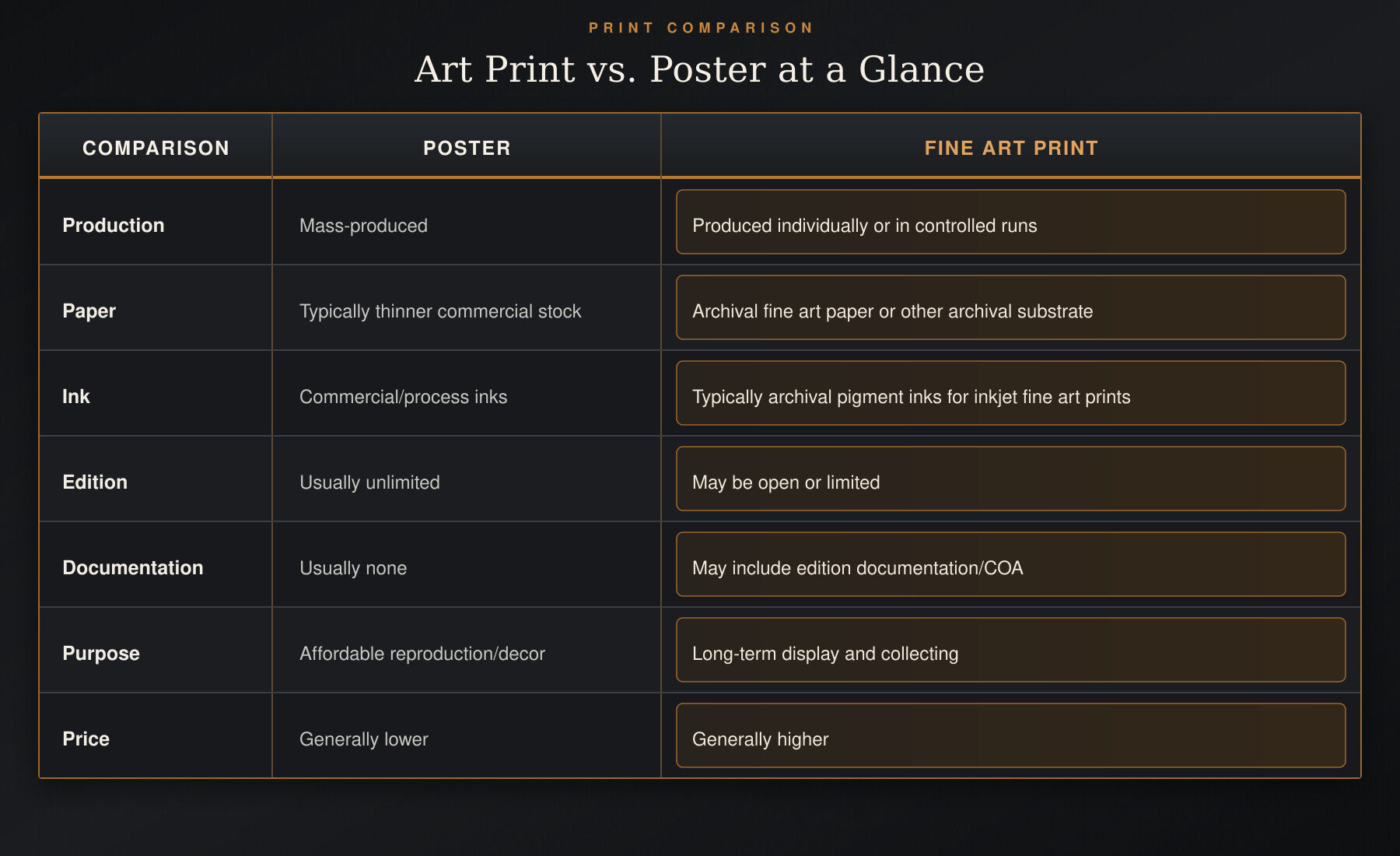
People use "art print" to describe almost anything with an image on it, which is exactly why the confusion exists. In the broadest sense, an art print is any artwork or photograph reproduced on paper. Under that umbrella live two very different animals.
An open-run poster comes off commercial presses by the thousands. Nobody tracks how many exist, and nobody ever will.
A fine art print is made individually using archival-quality materials and may be released in a numbered, documented edition.
The rest of this article unpacks what separates the two, layer by layer: the paper, the ink, the process, and the edition.
What Makes a Poster a Poster
Poster printing, in the plain sense, means reproducing an image at volume on a commercial offset or digital press, using process inks on thin coated paper. A poster is a product of scale. Spread the setup cost across a run of thousands and each copy costs pennies to make. That’s why it sells for the price of a dinner out, and when a poster does carry a bigger price tag, you’re usually paying for licensing or a frame, never the materials.
Nothing about that is a scam. Posters put images on walls almost anyone can afford, and the world is better for it. But the materials tell you what to expect. Thin paper cockles and dents. Process inks fade, and they fade fast in sunlight. Hang a poster in a bright room and you can watch the reds give up over a couple of summers. The paper itself usually carries acids and brighteners that yellow and shift with age. A poster is built to be enjoyed now and replaced later.
Hold one up next to a fine art print and your hands will know the difference before your eyes do.

What Makes a Fine Art Print Different
A fine art print is an artwork or photographic image produced with high-quality materials and close control over the finished result. In photographic printing, that often means archival pigment inks on cotton or other fine art paper, although fine art photographs can also be presented on materials such as acrylic or metal. Limited editions and certificates of authenticity may add scarcity and documentation, but the materials, printing process, and artist's control are what distinguish the physical object.
The paper
Fine art prints start with museum-grade stock, most often 100 percent cotton rag. Cotton carries no wood acids, so it doesn’t yellow. The best sheets also skip optical brighteners, the additives that fade over decades and shift a print’s color as they go. In my studio, the two papers that earned a permanent place are Moab Juniper Baryta Rag and Canson Infinity Platine Fibre Rag, both heavyweight cotton sheets I chose for their extremely high Dmax, the deep black density that lets a print carry real contrast without losing shadow detail.
The ink
Posters use dye-based or process inks that sit on the surface and break down under UV light. Fine art prints use pigment inks: microscopic particles of stable color bonded to the paper. Pigment is the reason a print can hang for generations while a poster gives up in a few years. It’s also half of what the word giclée means. The term came out of the early days of fine art inkjet, and today it simply describes a pigment print on archival stock. If a seller can’t tell you the ink and the paper behind their giclée, keep your wallet in your pocket.
The process
A poster gets printed once, at scale, and shipped. A fine art print gets made. Before a new image enters my catalog, I proof it, adjusting contrast and color until the paper matches what I saw in the field. Then I print every paper edition myself, in-house. That last part matters more than people think. The photographer who stood in the fog is the same person judging whether the fog looks right on paper.
The edition and the certificate
Scarcity is the final difference, and for collectors it’s the one with teeth. My editions are capped at one hundred per image, shared across every size and every substrate. When they’re gone, they’re gone. Each purchase ships with a certificate of authenticity documenting the piece and its edition, which is a paper trail no poster will ever have. Caps and certificates are how a print holds its footing in the art market, while an open-run poster, by design, cannot. I go deeper on how my edition sizes and print materials work if you want the full picture.

Why the Price Gap Is What It Is
Line up the receipts and the gap stops looking mysterious. Museum-grade cotton costs real money per sheet. Pigment ink costs more per ounce than good perfume. Proofing burns paper and time. And the image itself carries the heaviest cost of all: the years in the field, the failed mornings, the one dawn in fifty when the fog and the light finally agree. A poster amortizes none of that because it doesn’t have to. A fine art print carries all of it, plus a promise: only a hundred of these will ever exist. That’s what you’re paying for, and it’s why two objects can share an image and share nothing else.
How to Tell the Difference Between a Poster and a Fine Art Print
You don’t need a loupe, but a loupe removes all doubt. Under magnification, an offset poster shows a rosette pattern of tiny uniform dots, the fingerprint of a commercial press. Digital posters skip the rosette but still show a visible dot structure and a thin, coated sheet underneath. A fine art print shows smooth, continuous color on heavy cotton.
No loupe? Use your hands and the light. Fine art paper is heavy and stiff, often 300 gsm or more, with a surface that feels like an object rather than packaging. Poster stock is thin, floppy, and shiny in a way that reads cheap the moment it moves. Check the back too: cotton rag is soft, matte, and unprinted.
Then look for the paperwork. A documented edition and a certificate of authenticity travel with fine art prints. And price is a tell all by itself. Nobody can sell you museum-grade cotton, pigment ink, and a capped edition for the price of a poster. The materials alone rule it out.
Lithograph vs Poster vs Fine Art Print
The word lithograph trips people up because it covers two objects that have almost nothing in common. An original lithograph is a fine art print in the truest sense: the artist draws on a stone or metal plate, and each sheet is pulled by hand in a small edition. Those are artworks, collected and priced accordingly. An offset lithograph is the commercial process behind most posters, the same press run described above. So when a listing says lithograph, ask which kind. The loupe settles it in seconds. Offset shows that uniform dot rosette. An original shows drawn texture and ink that sits on the paper with real character.
Where a Poster Makes Sense (and Where It Doesn’t)
Buy the poster for a dorm, a kid’s room, a rental you’ll leave in a year, or a movie you love. Buy it to test-drive an image before committing to the real thing. Posters are the right tool for temporary walls and casual affection, and I mean that without a hint of snobbery.
Museum and exhibition posters deserve a word here too. That framed Monet poster from a museum shop is an open-run offset reproduction. Frame it, enjoy it, just don’t confuse it with something collectible. It’s a souvenir of a painting, and souvenirs have their place.
The equation flips on the walls you actually live with. The piece over the fireplace, the anchor of a dining room, the view you’ll stare at for the next twenty years: that’s fine art print territory. You’re buying materials that hold their color for generations, a documented edition, and work that was made rather than manufactured. If you’re weighing what belongs in a specific room, my guide to choosing the right photograph for a space walks through it. And if you’re newer to all of this, start with why fine art photography is worth collecting.
I’ll leave you with the simplest version of all this. A poster is a picture of an image. A fine art print is the image, finished, the way the photographer meant it to exist in the world. Both belong somewhere. Figure out which wall you’re standing in front of, and the choice usually makes itself. And if it doesn’t, ask me. I’ve talked more collectors out of a print than into the wrong one.

Questions Buyers Ask About Posters and Prints
What is the difference between an art print and a poster?
A poster is typically mass-produced on commercial paper using process or digital printing, while a fine art print is produced with greater control using archival-quality materials such as pigment inks and fine art paper. Posters are usually unlimited and inexpensive; fine art prints may be limited, documented, and intended for long-term display or collecting.
Is an art print the same as a poster?
Not necessarily. “Art print” is a broad term that can describe many reproductions of artwork, including inexpensive open-run prints as well as archival fine art prints. To understand what you're buying, look beyond the label and ask about the paper or substrate, ink or printing process, edition structure, and documentation.
What is an art print?
An art print is any artwork or photograph reproduced on paper, which is why the label alone tells you so little. The term covers everything from open-run posters to museum-grade fine art prints. What matters is the paper, the ink, and whether the edition is limited and documented.
What is a board print?
A board print is an image printed on or mounted to a rigid panel, most often foam board, so it can hang or stand without a frame. It’s an affordable display option that sits closer to a poster than a fine art print in both materials and lifespan.
What is the difference between a print and a lithograph?
An original lithograph is pulled by hand from a stone or plate the artist drew on, and it’s an artwork in its own right. An offset lithograph is a commercial reproduction, the process behind most posters. Magnification tells them apart: offset shows a uniform grid of dots.
What is a giclée print?
Giclée describes a fine art inkjet print made with archival pigment inks on museum-grade paper or canvas. The word signals quality but has no legal definition, so ask two questions of any seller: which ink and which paper. A genuine giclée answer names both without hesitation.
Do posters fade faster than fine art prints?
Yes. Posters pair process or dye-based inks with acidic paper, and both break down with light exposure, often within a few years on a bright wall. Fine art prints pair pigment inks with acid-free cotton paper and hold their color for generations under normal display.