THE 13 CLASSICAL PHOTOGRAPHERS WHO DEFINED THE EPIC BEAUTY OF AMERICA'S NATIONAL PARKS
Some of the most influential and famous landscape photographers in history built their work around America’s national parks and the wider American West. Long before widespread tourism, their photographs shaped how these places were seen, understood, and in some cases protected. Carleton Watkins’s Yosemite photographs were associated with the 1864 Yosemite Grant, William Henry Jackson’s Yellowstone photographs traveled to Washington with the Hayden Survey, and Ansel Adams later became one of the best-known artist-advocates in the long relationship between photography and conservation.
America’s national parks did not just shape how the country understood its landscapes. They helped shape landscape photography itself. A relatively small group of photographers established the visual language that still defines the genre: compositional clarity, tonal discipline, respect for structure, and an understanding that beauty could carry public consequence. In many cases, their photographs did not simply record a place. They changed how later photographers learned to see.
What follows isn’t a list of everyone who has photographed national parks. It’s a lineage of famous landscape photographers whose contributions were distinct enough to change what came after them.
Most Influential Landscape Photographers in This Tradition
- Carleton Watkins
- Timothy O’Sullivan
- William Henry Jackson
- Ansel Adams
- Edward Weston
- Eliot Porter
- Philip Hyde
- Galen Rowell
- Jack Dykinga
- Paul Caponigro
- Edward Burtynsky
- Michael Fatali
What Defines Classical Landscape Photography
The term “classical” here doesn’t simply mean early. It refers to a way of working. Classical national park photographers were shaped by large-format cameras, limited exposures, physical hardship, and a direct connection to the conservation movement. Their work inherited the visual logic of the Sublime and Picturesque method of landscape painting and translated it into photographic form. Monumental scale, layered depth, strong tonal structure, and an emphasis on clarity over manipulation became the hallmarks of the genre. Carleton Watkins transported mammoth-plate equipment into Yosemite, Timothy O’Sullivan worked on government expeditions across the West, and Ansel Adams later helped formalize exposure and tonal thinking through the Zone System he developed with Fred Archer in the late 1930s.
Just as important, many of these photographers understood that landscape photographs were never purely neutral. Jackson’s Yellowstone photographs and Moran’s paintings were described by the National Archives as “powerful testimonials” when Hayden went to Washington to advocate protection for Yellowstone. Adams later used his Sierra Club work and his book Sierra Nevada: The John Muir Trail in support of Kings Canyon National Park. Eliot Porter and Philip Hyde would continue that conservation tradition in different ways.
1. Carleton Watkins (1829–1916)
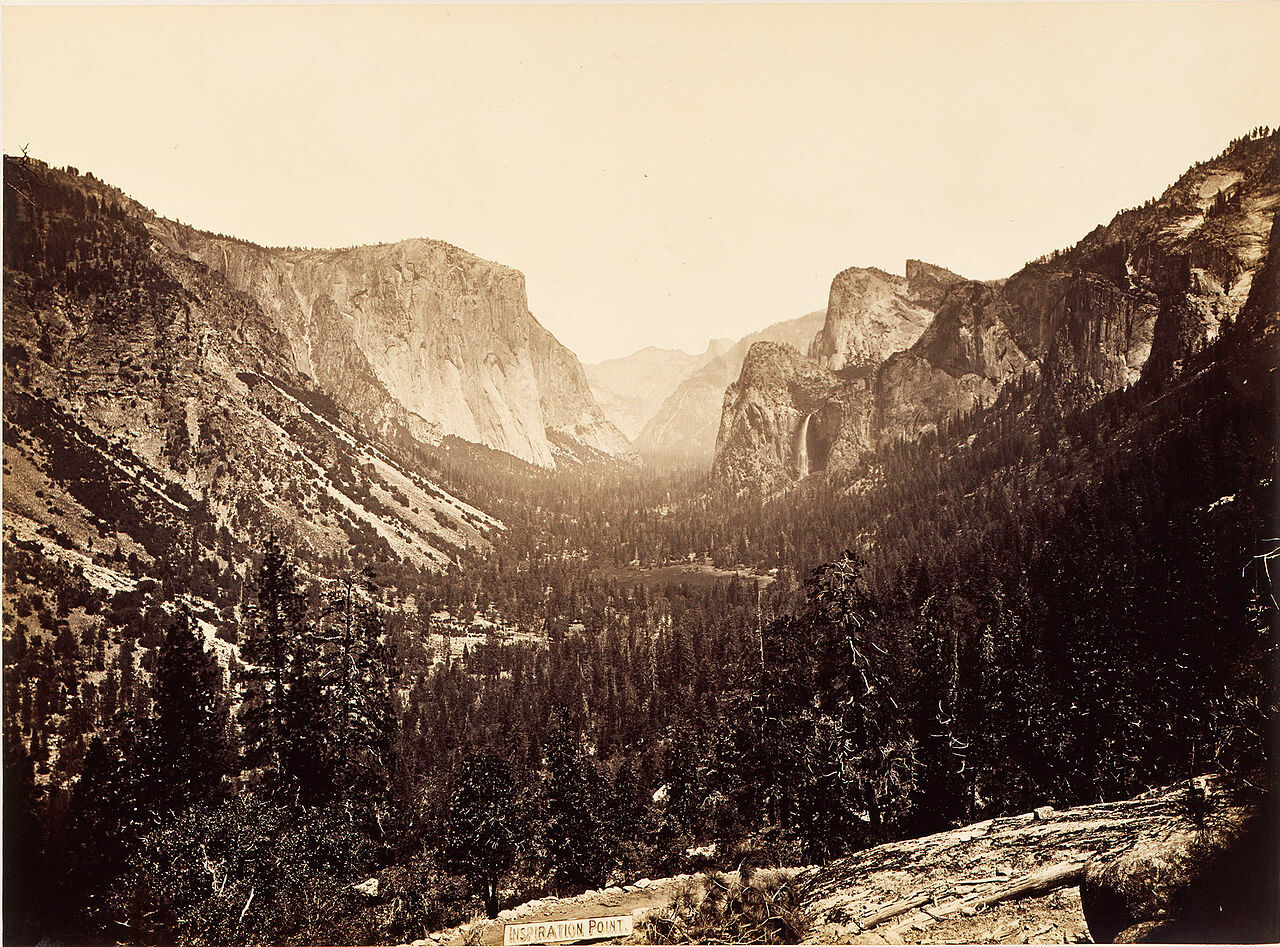
If American national park photography has an origin point, it’s Watkins. His mammoth-plate photographs of Yosemite in the 1861 and 1865 expeditions revealed the valley with an unprecedented combination of clarity and scale. He worked with glass plates measuring up to 18×22 inches, transported by mule teams into terrain that had barely been mapped. The physical constraints of the process demanded absolute compositional discipline. The resulting images don’t look improvised. They look inevitable.
Watkins’ photographs were shown to Abraham Lincoln and members of Congress as part of the case for the Yosemite Grant Act of 1864. This was the first time the federal government set aside land specifically for public preservation. The argument for Yosemite was partly made in pictures, and Watkins made those pictures. No other photographer in this lineage can claim a more direct legislative consequence.
2. Timothy O’Sullivan (1840–1882)
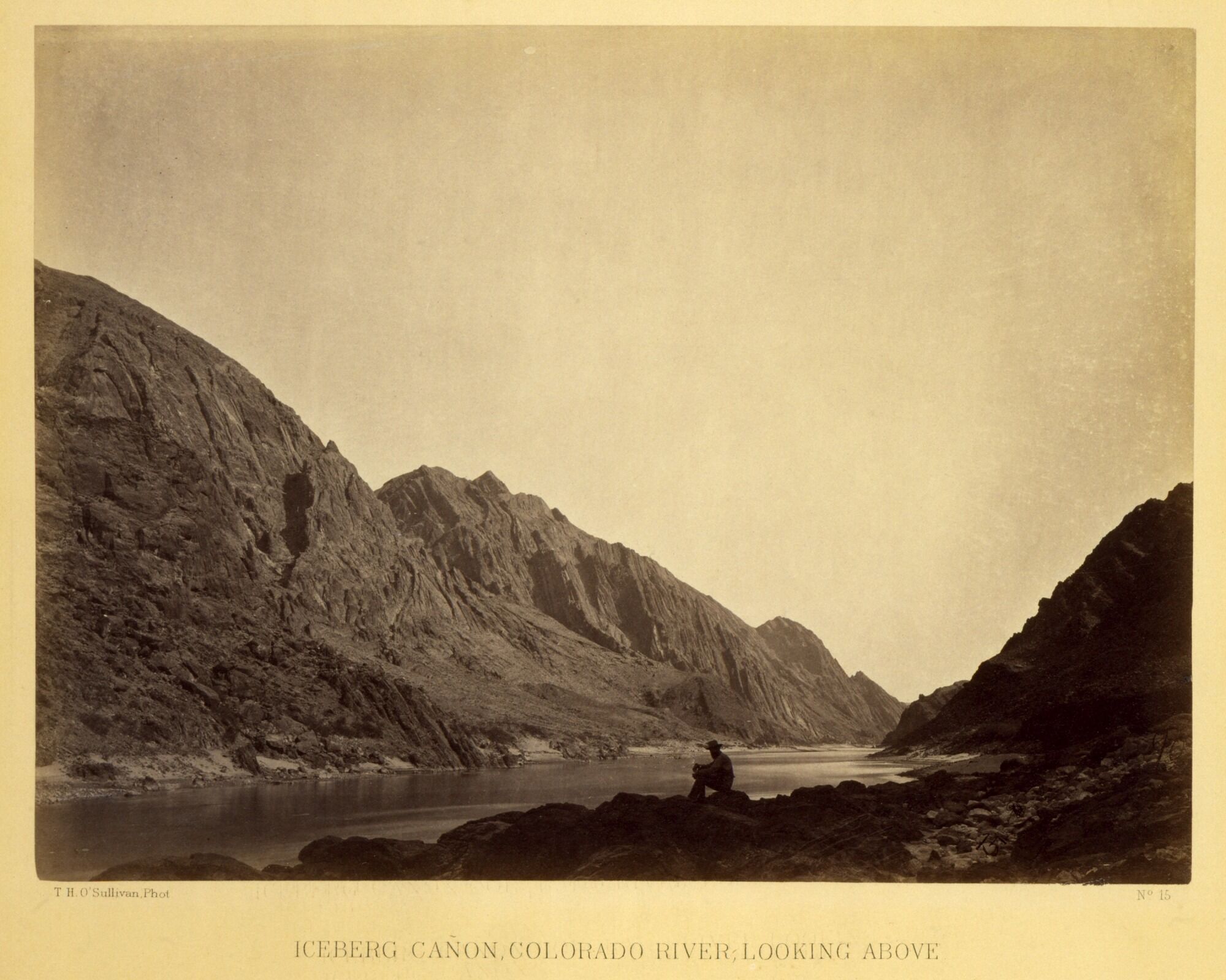
Timothy O’Sullivan’s photographs of the West feel startlingly modern because they often strip landscape down to structure. During the late 1860s and 1870s he traveled west on geological and topographical surveys, and surviving collections document images of Canyon de Chelly, the Colorado River, the Grand Canyon, and other western landscapes made in connection with those expeditions.
O’Sullivan worked as a photographer on multiple government survey expeditions in the late 1860s and 1870s, producing images that were technically documentary but compositionally far more sophisticated than their institutional purpose required. The tension between scientific record and visual statement in his work is exactly what makes it feel contemporary. Many photographers working today in the American desert are working in his register without knowing it.
Where Watkins often established grandeur through balance and scale, O’Sullivan made room for austerity. He helped move western landscape photography toward geology, topology, and visual restraint.
3. William Henry Jackson (1843–1942)
William Henry Jackson photographed Yellowstone in 1871 as part of the Hayden Geological Survey, at a moment when most Americans had no reliable picture of what the interior West actually looked like. His images of geysers, hot springs, and mountain ranges made with an 11×14 camera and, on some expeditions, a format as large as 20×24, were among the first visual evidence that the landscape descriptions coming back from surveyors were not exaggerated.
The following year, Congress established Yellowstone as the world’s first national park. Jackson’s photographs, presented alongside Moran’s paintings in congressional testimony, provided the visual proof that the landscape was real, specific, and extraordinary enough to protect.
What I find remarkable about Jackson, working now from the Pacific Northwest, is how clearly he understood that a photograph could carry an argument without spelling it out. The images don’t editorialize. They simply show what is there, at a scale and clarity that made dismissal impossible. That discipline is something I come back to whenever I’m working in terrain that deserves protection. The photograph either earns the argument or it doesn’t. Jackson’s did.

4. Ansel Adams (1902–1984)
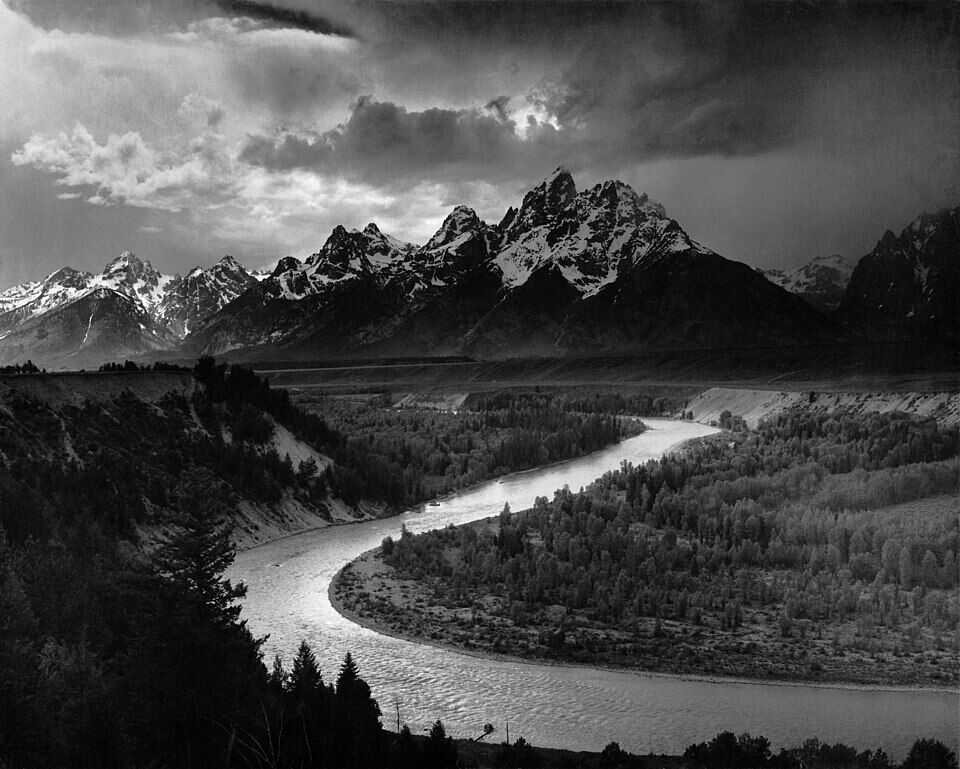
Ansel Adams is the most famous landscape photographer in this lineage and the name most people still associate with American wilderness photography. His images of Yosemite, Kings Canyon, the Tetons, and the Southwest are so widely reproduced that they risk becoming wallpaper.
Adams developed the Zone System in the late 1930s with Fred Archer, formalizing how photographers could pre-visualize tonal relationships before exposure and control them through development. This gave the classical emphasis on clarity and tonal structure a rigorous method. It meant that the quality visible in an Adams print wasn’t accidental or purely intuitive. It was reproducible, teachable, and it changed how serious photographers thought about the relationship between seeing and making.
Adams was also a committed environmental advocate who used his photographs deliberately and strategically. His work for the Sierra Club, his correspondence with government officials, and his campaign for Kings Canyon National Park were not separate from his photography, but part of the same project. He believed that showing the land at its best could help secure its future. Whether that belief was aesthetically limiting is a legitimate question. Whether it was consequential is not.
5. Edward Weston (1886–1958)
Edward Weston resisted the landscape tradition for most of his career, and that resistance shaped his contribution to it. Where Adams worked within an inherited visual language and refined it, Weston approached the land as a modernist who was concerned with form, structure, and abstraction rather than place or preservation. His Point Lobos images and his photographs of the Mojave and the California coast are less about where he was than about what he saw: the way a rock face simplifies into planes of shadow, the way sand creates repeating geometry, the visual logic of an eroded hillside.
Weston wrote that a photograph was never simply about what stood in front of the camera, it was also about what the photographer chose to isolate and reveal. That argument had significant influence. It authorized a generation of landscape photographers to think about their subject matter as visual material rather than documentary subject, opening a space between pure record and pure abstraction that much subsequent landscape photography has occupied.
6. Eliot Porter
Eliot Porter challenged the assumption that national park photography required grand views to matter. Where the earlier figures in this lineage worked primarily in black-and-white and at monumental scale, Porter photographed intimate scenes in color such as leaves, streams, and forest floors. His 1962 book In Wildness Is the Preservation of the World, produced with the Sierra Club, demonstrated that landscape photography could make a conservation argument through accumulation of small details rather than proclamation of large ones.
His work arrived at a moment when color photography was not yet fully accepted as a serious fine art medium. By bringing the same compositional rigor to color that his predecessors had brought to black-and-white, and by insisting that the quotidian details of a landscape were as worthy of attention as its peaks, Porter permanently expanded the visual vocabulary of national park photography. If your own eye is drawn to quieter detail, to places where structure lives in accumulation rather than spectacle, Porter is one of the essential predecessors.
7. Philip Hyde (1921–2006)
Philip Hyde is less celebrated than Adams or Porter, but the Sierra Club’s own account of his career makes clear how substantial his contribution was. He photographed in steady, unshowy light, often avoiding dramatic conditions entirely. He returned to the same locations repeatedly over years and decades, building a cumulative visual argument about what a place was and what it was worth preserving.
Hyde’s career was closely tied to specific conservation campaigns such as the fight against dams in Dinosaur National Monument, the battle over Glen Canyon, and the protection of the California desert. His photographs were made as tools in ongoing environmental debates, with the aesthetic quality serving the argument rather than existing apart from it. His photographs show how landscape photography can serve public consequence without losing grace.
8. Galen Rowell (1940–2002)
Galen Rowell brought speed, athleticism, and a more participatory relationship to the landscape. He traveled fast and light, carrying 35mm equipment into terrain that larger-format photographers couldn’t access with their equipment, and he worked at the edges of weather systems in a brief clearing after a front passed through. Many of his best-known images were made in windows that lasted seconds.
His contribution to the lineage was partly technical and partly philosophical. He demonstrated that 35mm could produce images of serious artistic quality in extreme conditions. At the same time, his book Mountain Light articulated a way of seeing that connected landscape photography to the physical experience of being in a place, as distinct from the contemplative, static approach of large-format work. Rowell established that 35mm systems could produce genuinely different kinds of images from genuinely different relationships to the land.
9. Michael Fatali (b. 1956)
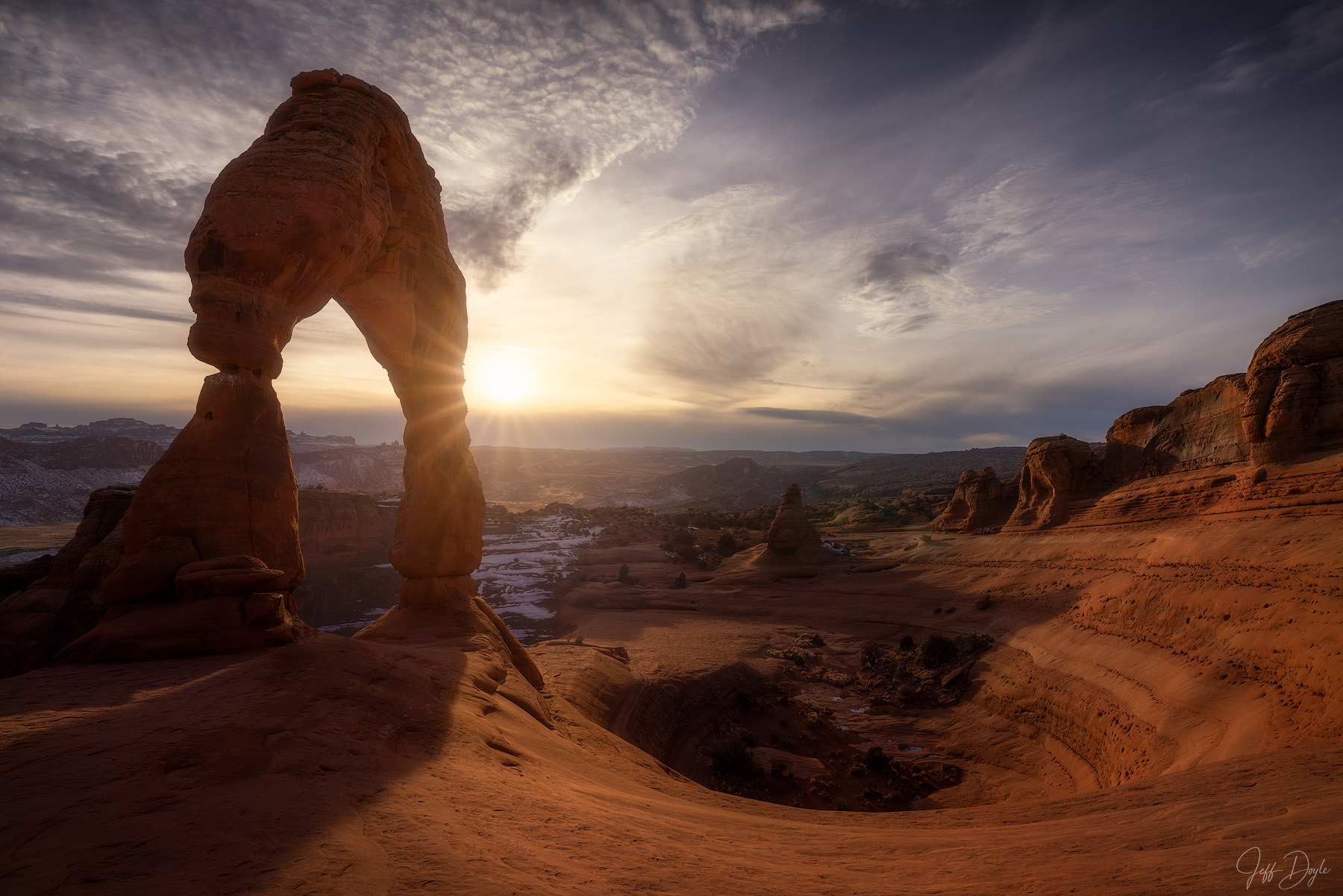
Michael Fatali occupies a later position in this story, but he is worth including because of the influence his Southwest work has had on contemporary desert photography. Fatali built his practice around familiarity rather than discovery. He returned to the same viewpoints in southern Utah such as Antelope Canyon, the Wave, and the arches of the Colorado Plateau over many years, working with large-format cameras that demanded slow setup and deliberate exposure. Rather than arriving at a location hoping for conditions, he developed an understanding of how light moved through specific spaces across seasons and years, and he waited for the convergence he already knew was possible.
His images of Antelope Canyon in particular helped introduce a wider public to slot canyon light in a way that hadn’t been done before. The classic images of shafts cutting through sandstone originated with Fatali. Antelope Canyon is now one of the most visited photography locations in the American Southwest, requiring tour guide accompaniment and timed entry. The experience of making an image there today is nothing like the solitude Fatali knew. What makes Fatali relevant here is the combination of repetition and place-knowledge. He belongs to the tradition of photographers who return again and again, learning how light behaves in the same landscape over years rather than treating the land as a one-time backdrop.
10. Jack Dykinga (b. 1943)
Jack Dykinga spent extended time in Sonoran and Chihuahuan desert environments learning how light behaves in sparse, reflective terrain. His large-format images of the American Southwest icons such as Arches, Canyonlands, and Saguaro hinge on small visual decisions: how shadow falls across stone, how a single stand of vegetation interrupts open space, how the foreground of a desert image can carry as much visual weight as the sky above it.
His book Stone Canyons of the Colorado Plateau, made in collaboration with writer Charles Bowden, is one of the more serious attempts to connect landscape photography to the specific ecology and geology of a place rather than treating the landscape as a backdrop. The photographs reward the kind of sustained attention that most contemporary photography actively discourages. He also won the 1971 Pulitzer Prize for Feature Photography for work published in the Chicago Sun-Times.
11. Paul Caponigro (b. 1932)
Paul Caponigro represents another branch of the classical tradition: the contemplative, interior, almost musical one. He has described his process as "waiting"; returning to a place repeatedly until it feels resolved, until the image presents itself rather than being taken. The results are less about describing terrain than about conveying a specific quality of attention through light and tonal structure.
His Stonehenge series, his sunflower photographs, and his New England landscapes all share a quality of stillness that is harder to achieve than it looks. Caponigro represents a branch of the classical tradition that prioritizes inner response over outer spectacle. It is closely related to Stieglitz’s concept of Equivalents, though arrived at independently. For photographers interested in what landscape photography can carry beyond description, his work is essential.
12. Edward Burtynsky (b. 1955)
Edward Burtynsky belongs in this lineage for a different reason. His work clarifies what national parks preserve by showing what exists where preservation has failed. His large-format images of oil fields, ship-breaking yards, mine tailings, and industrial agriculture apply the visual language of classical landscape photography to landscapes that have been comprehensively altered by industrial activity.
The effect is deliberate and significant. By using the same visual seriousness that Adams and Porter brought to wilderness, Burtynsky makes it impossible to dismiss his subjects as merely ugly or merely industrial. They are landscapes, with all the visual complexity that word implies, and they demand the same quality of attention. Placed against the national park tradition, his work functions as a before-and-after argument that no amount of rhetoric could make as effectively.
Understanding the classical tradition fully requires understanding it was arguing against the transformation of land into resource, and Burtynsky makes that argument visible.
Why These Famous Landscape Photographers Still Matter
The photographers in this list share something more specific than a subject. Most returned to the same places over years, learning how landscapes changed across seasons and light conditions. Their images grew from familiarity rather than novelty. Watkins came back to Yosemite across decades. Weston made Point Lobos one of the longest-lasting subjects of his career. Adams returned to Yosemite and the Sierra for the whole of his working life. They treated editing as seriously as composition. And most of them understood that the beauty they were recording was contingent, that it existed because decisions had been made to protect it and would require further decisions to keep it.
That is the deeper argument running through the history of famous landscape photographers. The images that last do not usually come from seeing a place once. They come from learning how the place changes. That is as true for Yosemite and Yellowstone as it is for the mountain landscapes, desert country, and quieter wildflower landscapes photographers continue to work in today.
I’ve been photographing the Pacific Northwest for over a decade, returning to the same coastlines, the same mountain flanks, the same river valleys in different seasons and light. What I keep finding is that the photographers in this lineage were right about the one thing that matters most: familiarity is not the enemy of vision. It’s the condition for it. The images that hold up don’t come from arriving somewhere new. They come from finally understanding somewhere you’ve already been. The argument isn’t finished. Neither is the work.
Modern Landscape Photographers and What Came After
National park photography did not end with these figures. Newer photographers brought color more fully into fine art practice, worked with smaller equipment, moved more quickly, or turned the tradition against itself by photographing environmental loss rather than protected grandeur. But the central questions remain the same. What does it mean to look carefully at land? What kind of picture can carry both beauty and consequence? And what responsibility comes with making a place visible to people who have never stood there themselves?
In the next article, I’ll look at contemporary photographers working in America’s national parks today to understand how their approaches extend, complicate, and sometimes contradict the classical tradition outlined here.