
What Is Luminism? Albert Bierstadt and the Art of Light in Landscape Photography
Luminism is a style of nineteenth-century American landscape painting known for its careful treatment of light, atmosphere, stillness, and expansive natural scenery. Luminist paintings often use subtle changes in tone, reflected light, atmospheric haze, and smooth surfaces to create a sense of depth and tranquility.
Albert Bierstadt is one of the painters most closely associated with the luminous, dramatic vision of the American landscape. His enormous paintings of mountains, valleys, lakes, storms, and the American West used light not simply to illuminate a scene, but to direct the viewer's attention and heighten its emotional impact.
That idea still resonates with me as a landscape photographer. I am also drawn to the grand landscape, especially when light transforms a mountain, canyon, desert, forest, or distant horizon into something that feels larger than an ordinary view. Photography and painting are very different mediums, but the visual problem is remarkably similar: how do you use light, composition, atmosphere, and scale to communicate what a place feels like?
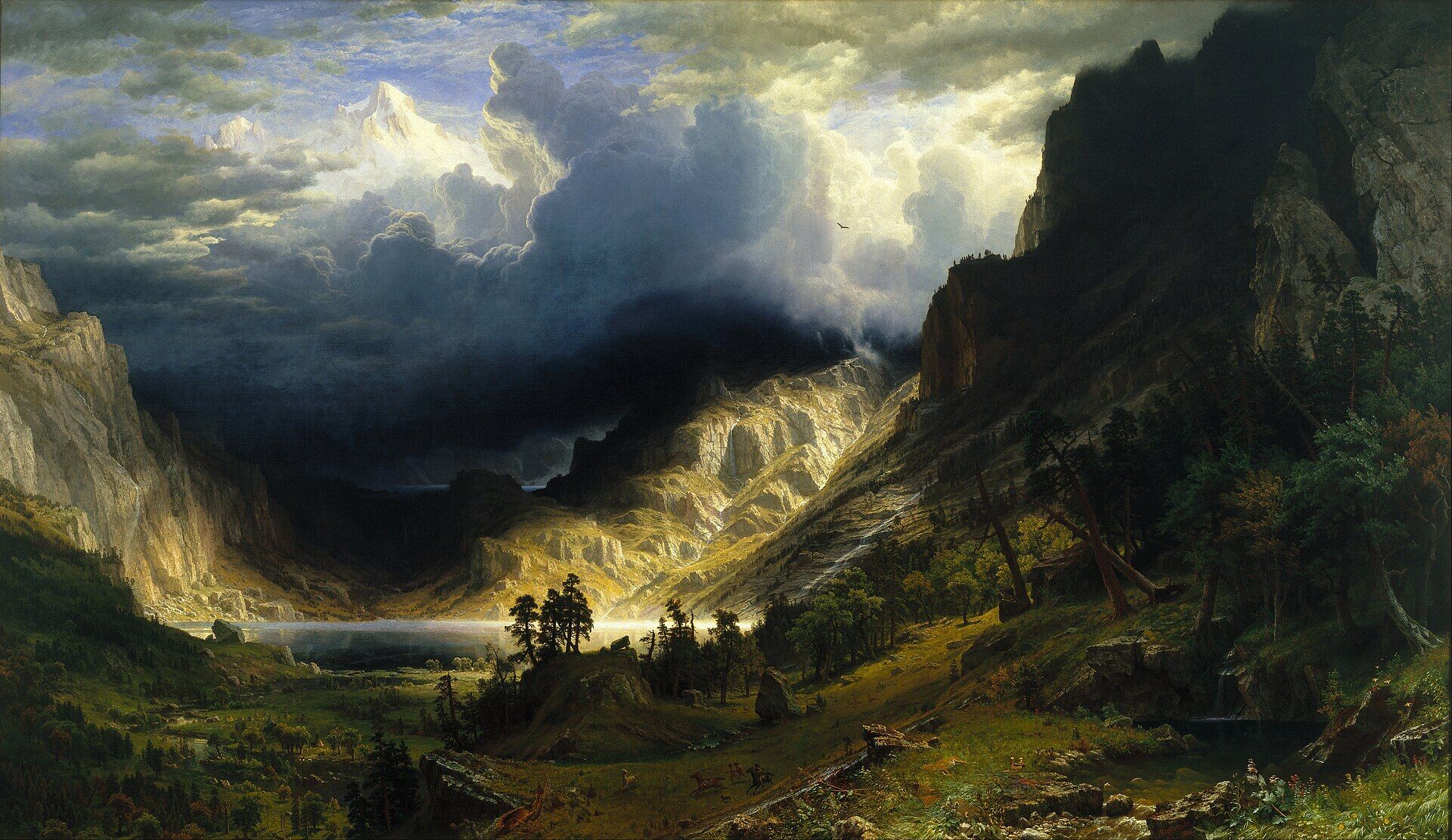
Luminism at a Glance
| Question | Answer |
|---|---|
| What is Luminism? | A nineteenth-century American landscape style associated with luminous light, atmosphere, stillness, precise detail, and smooth tonal transitions. |
| When did Luminism develop? | It is generally associated with American landscape painting between about 1850 and 1875. |
| Was Luminism part of the Hudson River School? | The two overlap significantly, although Luminism is generally treated as a more specific art-historical description rather than a formal school. |
| Was Albert Bierstadt a Luminist? | Bierstadt is strongly associated with the Hudson River School and his paintings frequently display qualities associated with Luminism, especially dramatic light, atmosphere, and expansive landscape. |
| What does Luminism have to do with photography? | Its emphasis on light, depth, atmosphere, composition, and visual guidance has clear parallels with modern landscape photography. |
What Is Luminism?
Luminism is a term used to describe an approach to American landscape painting in which light and atmosphere become central parts of the image. Instead of relying on obvious brushwork or theatrical gestures, many paintings associated with Luminism use controlled tonal transitions, careful detail, calm water, reflective surfaces, haze, and expansive skies to create a quiet but powerful sense of space.
The landscapes can feel remarkably still. Light may spread across water, illuminate distant mountains, or appear through layers of atmosphere so gradually that it becomes part of the structure of the painting itself.
That treatment of light is one reason these paintings remain so compelling. A landscape is not simply a collection of mountains, trees, water, and clouds. Light establishes hierarchy. It tells us what to look at first, which areas should recede, where the eye should travel, and which parts of the scene carry the most emotional weight.
What Defines Luminism in Art?
There is no single formula for a Luminist painting, but several visual qualities appear repeatedly in works associated with the style:
- careful observation of natural light
- smooth transitions between light and shadow
- atmospheric depth and distant haze
- calm or reflective water
- large expanses of sky
- precise detail without obvious brushwork
- strong spatial organization
- a sense of quiet, contemplation, or grandeur
Not every painting contains all of these elements. What connects them is the unusually important role that light and atmosphere play in creating a sense of place.
Where Did Luminism Come From?
Luminism developed within the larger tradition of nineteenth-century American landscape painting. Many of the artists associated with it are also connected with the Hudson River School, an informal group of painters who became known for detailed and often romantic views of the American landscape.
The Hudson River School was not a literal school with classrooms or a formal curriculum. It was a later name for artists who shared overlapping interests in nature, landscape, exploration, light, atmosphere, and the emerging visual identity of the United States.
That larger movement helped establish landscape as a subject worthy of monumental treatment. Mountains, forests, rivers, storms, valleys, and wilderness could be presented with the scale and seriousness traditionally reserved for historical or religious subjects.
For the broader story of how painting and other artistic traditions influenced the development of landscape photography, see my History of Landscape Photography.
Why Wasn't It Called Luminism at the Time?
One of the interesting things about Luminism is that the artists themselves were not necessarily walking around describing their work as "Luminist." The term was applied retrospectively by twentieth-century art historians attempting to describe recurring visual qualities in a group of nineteenth-century American paintings.
The term was coined in 1954 by John I.H. Baur, director of the Whitney Museum of American Art, who applied it to a group of American paintings made roughly between 1850 and 1875. The painters themselves never used it.
That makes Luminism a useful description, but also one that deserves some flexibility. Art movements rarely fit into perfectly clean boxes, and individual painters can overlap several traditions at once.
Who Were the Luminist Painters?
A number of nineteenth-century American landscape painters are associated with Luminism or with works that display Luminist characteristics. The names most central to the style are usually Fitz Henry Lane, John Frederick Kensett, and Martin Johnson Heade, along with other artists connected to the Hudson River School and related landscape traditions.
Rather than treating Luminism as a rigid membership list, I find it more useful to look at what these artists were doing visually. Their paintings show an intense awareness of atmosphere, reflections, tonal relationships, spatial depth, weather, and especially the way light can turn an ordinary landscape into something transcendent.
Was Albert Bierstadt a Luminist?
Albert Bierstadt is most commonly associated with the Hudson River School and with monumental paintings of the American West. Many of his works also display qualities strongly associated with Luminism, including glowing atmospheric light, careful gradations of tone, reflective water, distant haze, and an extraordinary sense of depth.
It is worth being precise here. Art historians usually place Bierstadt in the second generation of the Hudson River School, and often with the Rocky Mountain School, rather than among the core Luminist painters like Fitz Henry Lane, John Frederick Kensett, and Martin Johnson Heade, whose work tends toward a quieter stillness than Bierstadt's grand drama. What Bierstadt shares with Luminism is its deep attention to luminous light and atmosphere, applied at operatic scale.
For that reason, Bierstadt is especially useful when thinking about the relationship between nineteenth-century landscape painting and modern landscape photography. His paintings are not restrained documentary records of what stood in front of him. They are carefully constructed visual experiences.
Light becomes a compositional tool. Foregrounds may be darker and more detailed, distant mountains softer and cooler, and illuminated valleys or clouds positioned so that the viewer's eye moves through the picture rather than stopping at the surface.
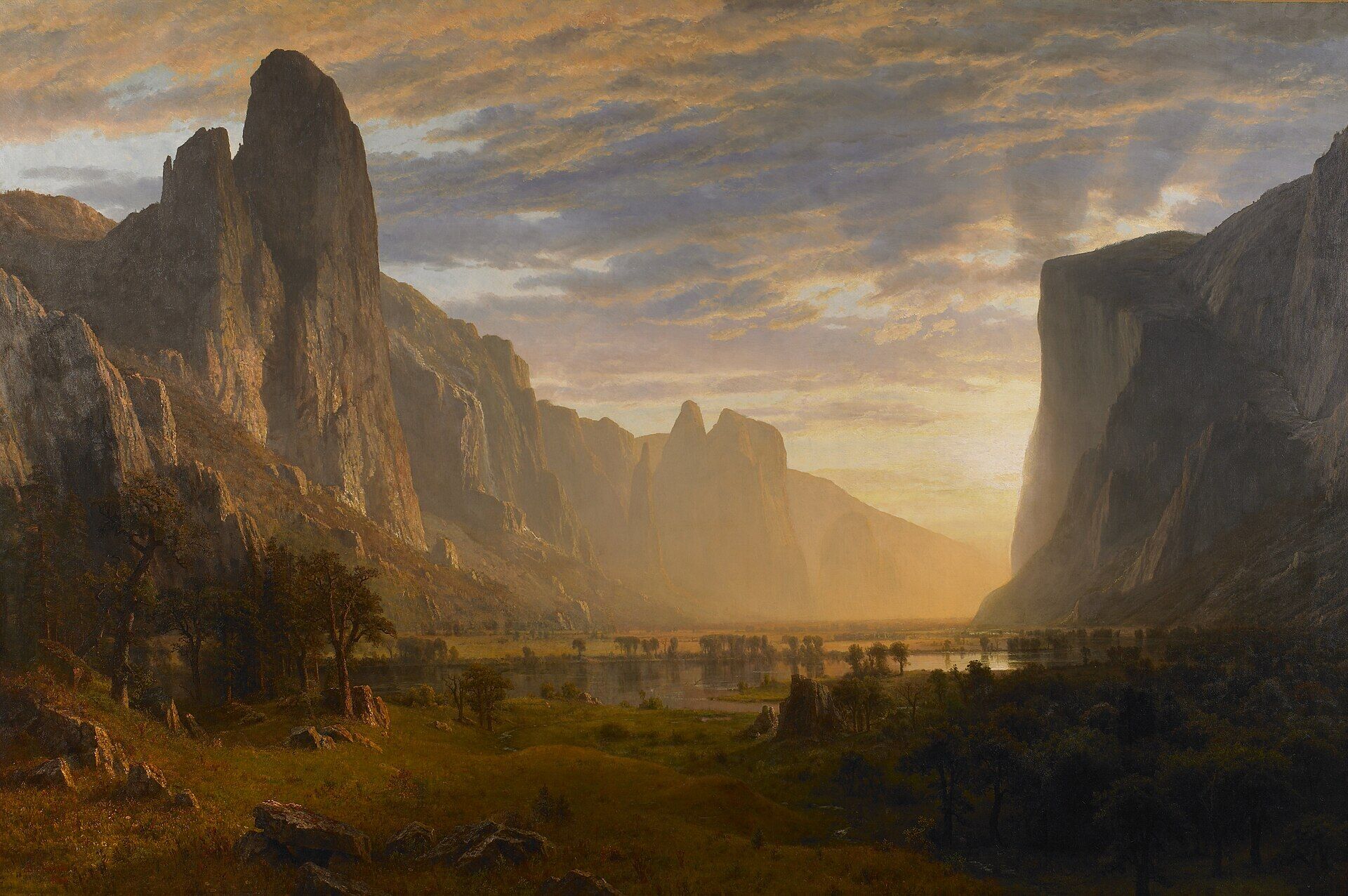
Who Was Albert Bierstadt?
Albert Bierstadt was a German-American landscape painter born in 1830. His family immigrated to the United States while he was young, and he later returned to Germany to study painting in Düsseldorf before establishing himself as an important American landscape artist.
After returning to the United States, Bierstadt became associated with the Hudson River School and gained recognition for his technical skill. His career changed dramatically when he traveled west and began producing paintings based on the landscapes he encountered.
Those journeys gave eastern audiences dramatic views of places many had never seen. The Rocky Mountains, Yosemite, the Sierra Nevada, western forests, lakes, and valleys became subjects for enormous paintings designed to surround the viewer with scale and spectacle.
Albert Bierstadt and the American West
Bierstadt became famous for portraying the American West on a grand scale. His paintings did not simply document geography. They glorified mountains, valleys, forests, weather, and wilderness through dramatic light and carefully orchestrated composition.
That part of his work is especially interesting to me because I am drawn to many of the same fundamental qualities in the landscape. I value the grand landscape. I want the viewer to feel the scale of a mountain range, the openness of a desert, the depth of a valley, or the way a beam of light can transform a distant ridge.
I am also interested in the visual grandeur of the West itself. The American West contains landscapes that invite a large visual response: immense mountains, sandstone canyons, desert mesas, high alpine valleys, wild rivers, and weather systems that can change the character of a place in minutes.
Bierstadt often glorified those environments through painting. As a photographer, I am working with a different medium and a different relationship to the scene, but I understand the attraction. There are places and moments when restraint is not the only valid response. Sometimes the landscape really does feel immense, dramatic, luminous, and extraordinary.
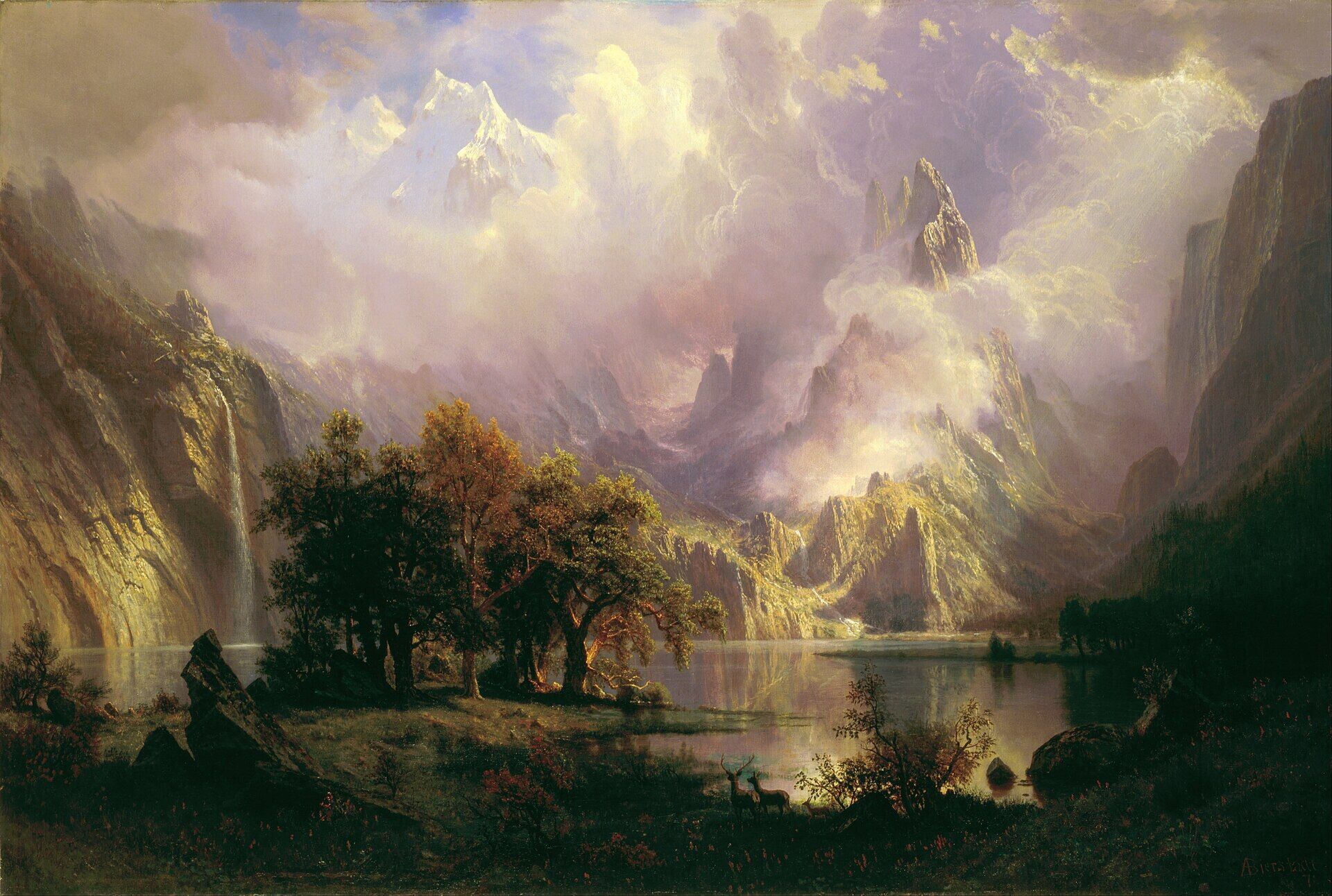
The Grand Landscape
In both painting and photography, the phrase grand landscape suggests more than simply using a wide-angle view. It is about creating a sense of scale, depth, atmosphere, and visual significance.
A grand landscape often depends on relationships between elements. A foreground gives the viewer an entry point. A middle distance creates transition. Mountains or clouds establish scale. Light separates forms and gives the scene hierarchy.
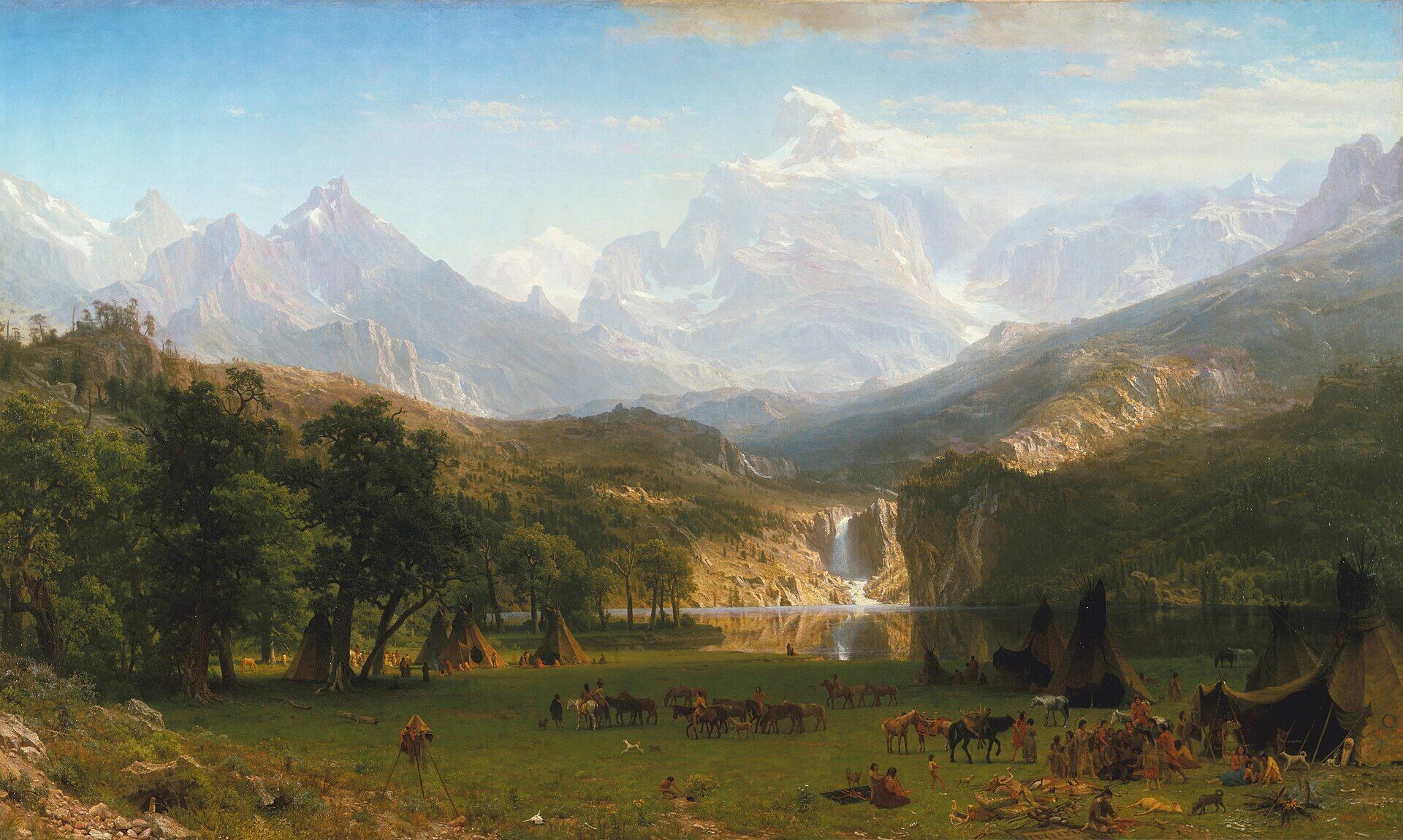
This is one reason Bierstadt's paintings remain useful to study. His compositions often contain multiple layers that move the eye gradually into the distance. Large foreground objects may establish scale, water may reflect light, and distant peaks can emerge through atmospheric haze.
I look for many of those same relationships in my own photography. I am not trying to imitate nineteenth-century paintings, but the underlying visual questions are timeless. Where does the viewer enter the photograph? What should attract the eye first? What creates depth? Where is the strongest light? What makes the landscape feel large?
How Bierstadt Used Light to Create Depth
One of Bierstadt's greatest strengths was using light to organize space. In many of his paintings, light does more than establish the time of day. It creates layers.
A dark foreground can make an illuminated valley seem brighter. Atmospheric haze can soften distant forms and make them appear farther away. Reflections can repeat important shapes while adding visual depth. Bright clouds can pull the eye toward the horizon and expand the apparent scale of the scene.
These are fundamental visual relationships, regardless of whether the medium is oil paint or photography.
Dark Foregrounds and Bright Distance
One common approach is to allow the foreground to remain relatively dark while the middle distance or background receives stronger light. The contrast naturally draws the eye deeper into the scene.
Landscape photographers encounter this situation frequently around sunrise, sunset, storms, and broken cloud cover. When the light falls selectively rather than evenly, the landscape can become much more dimensional.
Atmospheric Perspective
Distance changes the way we see color, contrast, and detail. Mountains far from the camera often appear softer, lighter, cooler, or more muted because of the atmosphere between the viewer and the subject.
Painters can exaggerate or refine that effect deliberately. Photographers often wait for conditions that create it naturally, such as haze, fog, rain, snow, smoke, or moisture in the air.
For me, atmosphere is not an obstacle that necessarily needs to be eliminated. It can be one of the most important parts of the photograph because it helps separate planes and communicate distance.
Reflections and Water
Bierstadt frequently used lakes, rivers, and reflective surfaces to expand his compositions. Reflections create repetition, symmetry, contrast, and another layer of light within the scene.
The same principle is powerful in landscape photography. Water can simplify a composition, reflect color from the sky, repeat the shape of a mountain, or create a visual path into the distance.
Light as a Visual Path
The brightest area of an image often attracts attention first. That means light can function almost like a leading line.
A sequence of illuminated surfaces can guide the viewer from foreground to middle distance and eventually toward the main subject. Clouds, ridges, water, trees, and openings in a canyon can all become part of that visual path.
I think about this constantly when photographing landscapes. Good light is not only beautiful. It helps organize the photograph.
Among the Sierra Nevada Mountains and the Power of Luminous Light
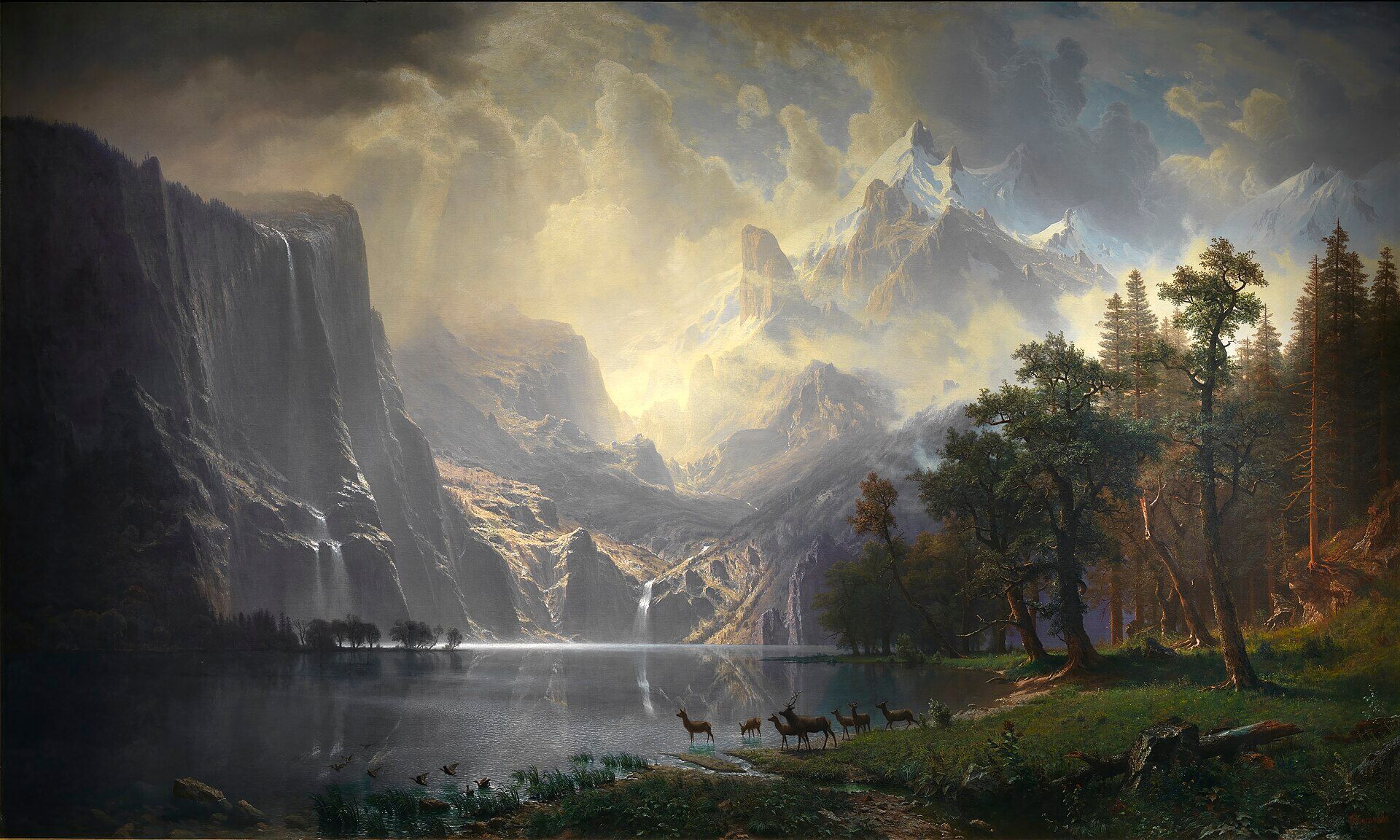
One of Bierstadt's best-known paintings, Among the Sierra Nevada Mountains, California, demonstrates many of the qualities people associate with his work. Mountains rise beyond calm water while warm light, mist, reflections, trees, and carefully arranged foreground elements create extraordinary depth.
The painting is not powerful simply because the mountains are beautiful. Bierstadt controls how the viewer encounters them. The eye moves through layers of foreground detail, reflective water, atmospheric light, and finally toward the distant peaks.
This is very close to the way I think about a successful landscape photograph. The subject may be spectacular, but spectacle alone is not enough. Composition and light still have to give the viewer a path through the image.
What Luminism Can Teach Landscape Photographers
Luminism is useful to photographers because it reminds us that light is not merely something that allows an exposure. It is one of the primary structural elements of an image.
A photographer cannot move the sun or paint light onto a mountain in the field, but we can make decisions about where to stand, when to photograph, which weather conditions to pursue, what focal length to use, and how to frame the relationships between bright and dark areas.
We can also choose how those relationships are expressed when processing and printing the image.
Wait for Light That Defines the Landscape
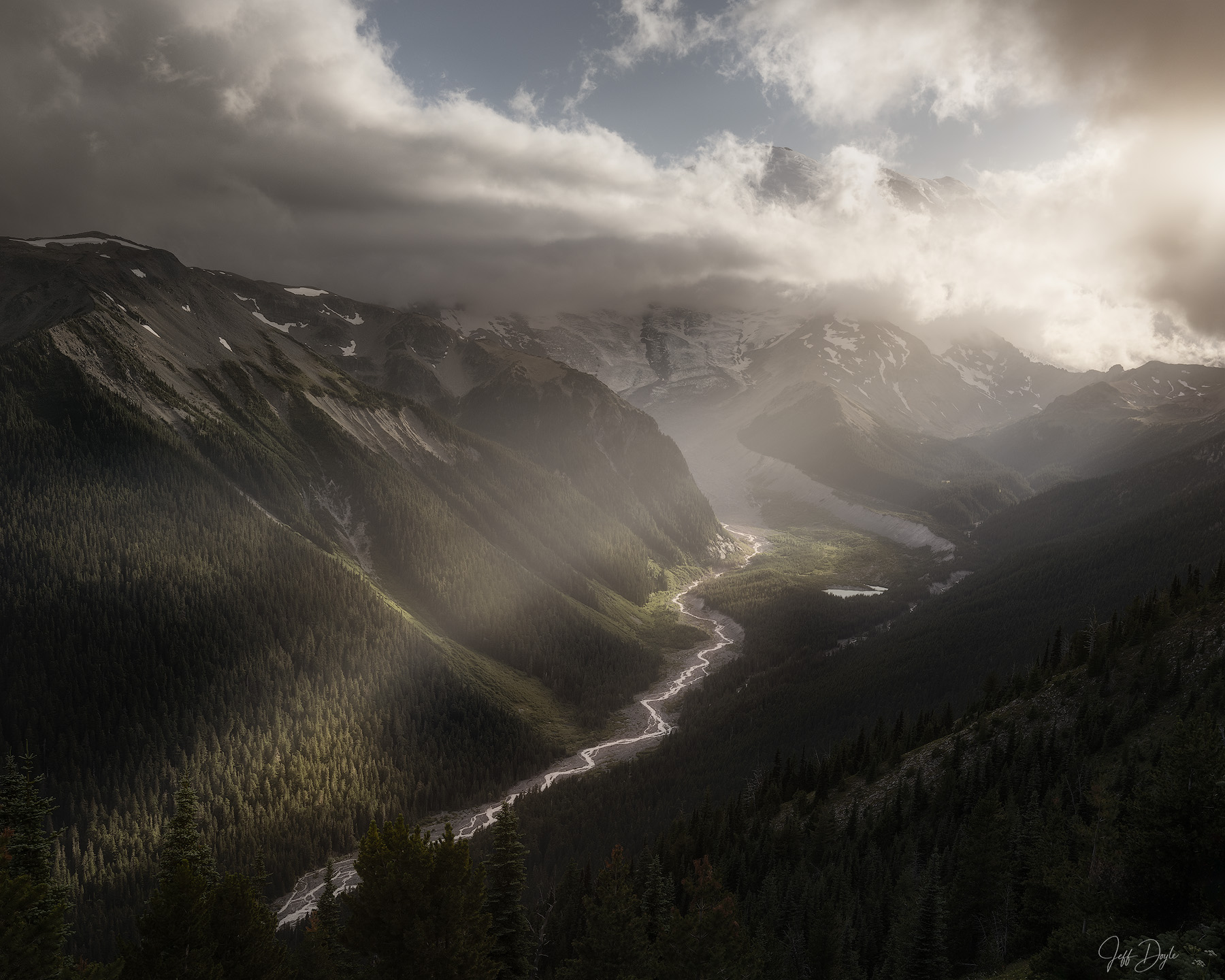
Flat light can reveal detail, but directional light often reveals form. Side lighting can show texture across mountain faces, canyon walls, dunes, trees, and clouds. Backlighting can make haze, mist, dust, or falling precipitation glow.
Some of the most exciting moments in landscape photography occur when the weather is unstable. A break in storm clouds can illuminate one mountain while everything around it remains dark. A shaft of evening light can move across a valley and disappear moments later.
Those moments are difficult to predict perfectly, which is part of what makes them valuable.
Use Contrast to Establish Hierarchy
Not every part of a photograph needs the same brightness, contrast, or visual weight. If everything competes equally for attention, the image can become difficult to read.
Bierstadt understood hierarchy exceptionally well. Important areas often receive stronger illumination or contrast while supporting areas remain quieter.
The same principle matters in my own photography. I want the viewer's eye to move toward the subject rather than wander without direction.
Use Atmosphere Instead of Fighting It
Fog, mist, rain, blowing snow, dust, and haze can reduce clarity, but they can also increase depth and mood. Layers that might appear visually compressed on a perfectly clear day can become separated when atmosphere changes their contrast and color.
This is one of the areas where photography can feel particularly close to Luminist painting. Light moving through atmosphere can transform the physical space between objects into a visible part of the image.
Let Scale Matter
Grand landscapes need a sense of proportion. Trees, rivers, people, roads, cliffs, or smaller mountains can help reveal the true size of larger subjects.
Bierstadt frequently used small figures, animals, trees, or foreground details against immense landscapes. Those elements give the viewer a reference point.
I also value scale in my own work because a photograph of the West should sometimes feel enormous. A mountain is not simply a shape on the horizon. The challenge is finding a composition that allows the viewer to feel something of its physical presence.
Luminism, Photography, and Post-Processing
Photography has never been limited to a completely mechanical reproduction of what the camera recorded. Photographers have long made decisions about exposure, contrast, brightness, local tonal control, printing, and presentation.
Techniques such as dodging and burning existed long before digital photography. They were used in the darkroom to selectively lighten or darken areas of a print, helping photographers control visual emphasis and tonal relationships.
Digital tools make those adjustments easier and more precise, but the underlying question has not changed: how should the tonal structure of the image guide the viewer?
I see post-processing as part of that interpretive process. The goal is not to make every area louder, brighter, or more saturated. It is to support the structure that made the scene compelling in the first place.
Painting and Photography: Similar Goals, Different Constraints
| Luminist Painting | Landscape Photography |
|---|---|
| The painter can construct and modify the landscape. | The photographer must begin with the scene that physically exists. |
| Light can be invented or moved. | The photographer usually waits for natural light or changes position to use it effectively. |
| Atmosphere can be created or exaggerated with paint. | Atmosphere is captured in the field and interpreted during processing. |
| Elements can be added, removed, or repositioned freely. | Composition depends heavily on viewpoint, timing, focal length, and framing. |
| Tonal relationships are developed directly on the canvas. | Tonal relationships are controlled through exposure, processing, and printing. |
| The artist can combine observations made at different times. | A photograph begins with a particular moment, even when the final interpretation involves careful processing. |
The differences are significant, but the artistic decisions often overlap. Both painter and photographer have to decide what matters most, what should recede, where the strongest light belongs, and how the eye should move through the composition.
Glorifying the American West
Bierstadt's paintings helped establish a powerful visual mythology around the American West. His mountains were monumental, his skies dramatic, and his valleys often bathed in extraordinary light. He emphasized grandeur deliberately.
There are complicated historical dimensions to nineteenth-century representations of the West, and those should not be ignored. At the same time, there is no denying the visual power of the landscapes themselves or the artistic attraction they held for Bierstadt and many other painters.
My own interest in the West comes from a different time and medium, but I recognize that same pull toward scale and light. I am attracted to landscapes that feel expansive, dramatic, and visually powerful.
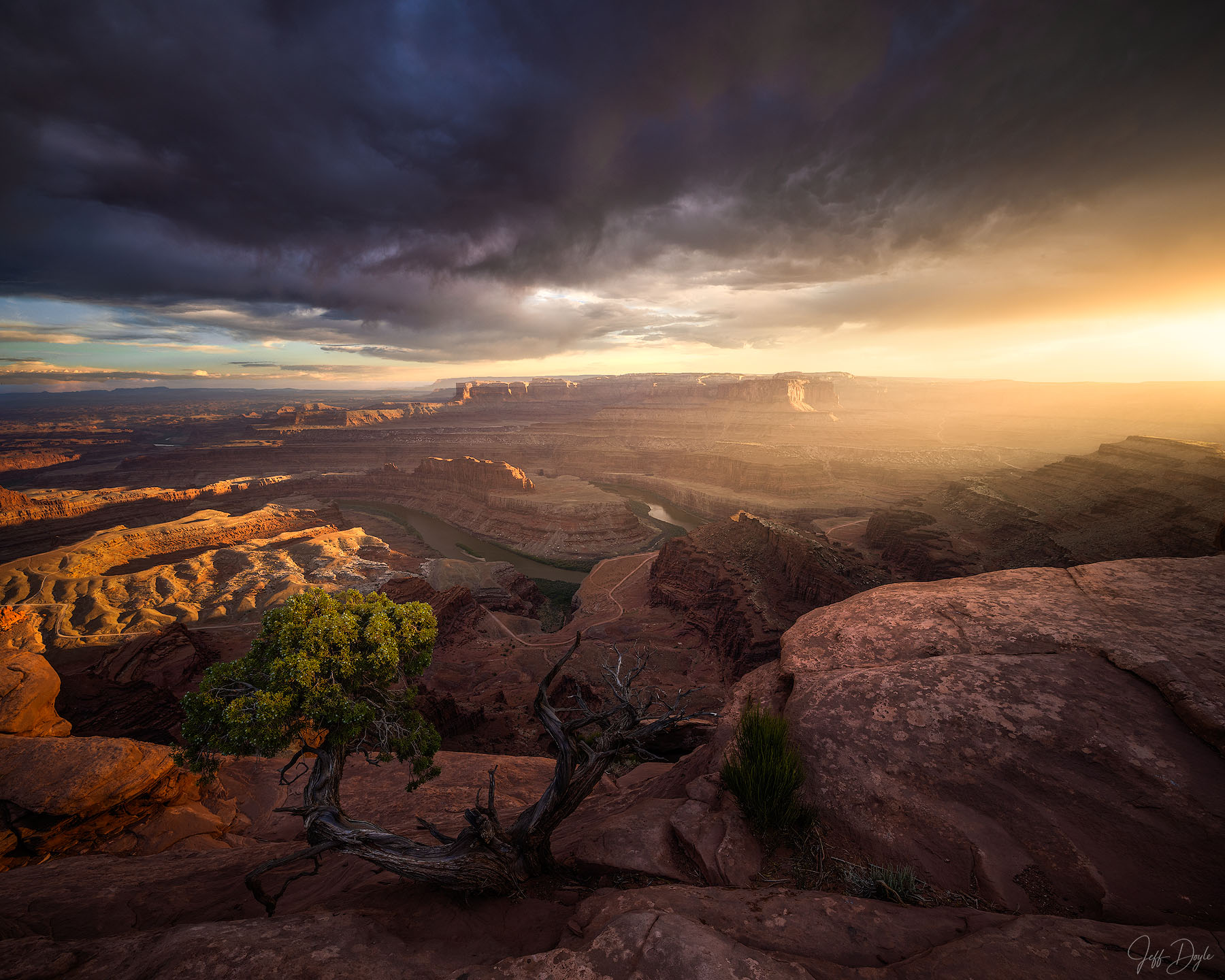
The American Southwest, the Rockies, high desert country, mountain valleys, waterfalls, forests, and the coast all offer moments when nature seems almost theatrical. When weather and light come together, the landscape can briefly look more dramatic than anything I could have planned.
That is part of what I want my photographs to communicate. I am not interested in shrinking those experiences into something timid simply because subtlety is fashionable. When the landscape is grand, I want the image to feel grand.
You can see that approach in my Fine Art Mountain Photography and American Southwest Landscape Photography collections.
When Nature Does the Work
One of the great differences between painting and photography is that a photographer often has to wait for nature to provide the conditions.
You can choose a location, study the terrain, watch weather forecasts, calculate where the sun will rise or set, and return to the same place repeatedly. None of that guarantees that the light will cooperate.
Then occasionally everything changes in seconds. A cloud opens. A beam of sunlight reaches a mountain. Mist catches the light. A storm passes across a valley while the horizon suddenly brightens.
Those are the moments I value most because the drama is not something I had to manufacture. The landscape supplied it. My job is to recognize what is happening quickly enough to build a composition around it.
That is another reason Bierstadt's paintings interest me. Even though he had the freedom to construct and intensify a scene with paint, the visual language he used often reflects real phenomena landscape photographers continue to chase: directional light, clearing storms, atmospheric haze, illuminated peaks, glowing horizons, and the contrast between shadow and sunlight.
How Luminism Still Appears in Landscape Photography
The phrase luminist photography is not necessarily a formal photographic movement in the same sense that Luminism is discussed within nineteenth-century American painting. It is more useful as a way of describing photographs that share some of the same visual concerns.
A photograph may feel Luminist when light and atmosphere are central to the experience of the image. Quiet water, glowing haze, layered mountains, subtle tonal transitions, reflected skies, soft distance, or carefully controlled contrast can all create that connection.
The strongest relationship is not a particular editing technique. It is a way of seeing.
The photographer is paying attention to how light creates space, how atmosphere separates planes, and how tonal relationships influence where the eye moves. Those ideas were important long before photography and remain important today.
Reading a Bierstadt Painting Like a Photographer
One useful exercise is to forget for a moment that a Bierstadt image is a painting and simply analyze its visual structure.
Ask where your eye goes first. Look at which areas are brightest. Notice where the strongest contrast appears. Study how foreground elements frame or introduce the scene, how the middle distance connects one layer to another, and how atmospheric haze reduces contrast toward the horizon.
Then look at the clouds. Are they simply background decoration, or do their shapes reinforce the direction of the light? Look at reflections. Do they duplicate the subject, expand the bright area of the composition, or lead the eye farther into the scene?
Those are exactly the kinds of questions I ask while working with a landscape photograph.
What Bierstadt and Luminism Mean to My Own Photography
I do not approach landscape photography by trying to recreate nineteenth-century paintings. What I share with artists like Bierstadt is an attraction to the emotional power of landscape and the importance of light in revealing it.
I value grand landscapes. I like depth. I like photographs that allow the eye to travel from foreground to horizon. I am drawn to weather, atmosphere, illuminated mountains, dramatic skies, reflected light, and the moment when one part of a landscape suddenly becomes more important because the light has found it.
I am also comfortable with beauty and grandeur as artistic goals. Landscape photography does not always have to apologize for being beautiful. The natural world can be overwhelming, peaceful, dramatic, subtle, violent, delicate, or luminous, sometimes within the same hour.
The challenge is to make a photograph that communicates something of that experience rather than merely proving that I stood there.
That may be the strongest connection I feel to Bierstadt's work. His paintings were intended to make people feel the landscape. That goal still makes sense to me more than 150 years later.
Frequently Asked Questions About Luminism
What is Luminism?
Luminism is an art-historical term associated with nineteenth-century American landscape painting. It is characterized by careful treatment of light, atmosphere, tonal transitions, detail, stillness, and expansive natural scenery.
What is Luminism in art?
In art, Luminism describes landscape paintings in which luminous light and atmospheric effects play an especially important role. Reflections, smooth surfaces, distant haze, large skies, and subtle changes in tone are common visual characteristics.
When did Luminism begin?
Luminism is generally associated with American landscape painting between about 1850 and 1875, during the broader era of the Hudson River School.
Was Albert Bierstadt a Luminist?
Albert Bierstadt is primarily associated with the Hudson River School and monumental paintings of the American West, and art historians usually place him with that school and the Rocky Mountain School rather than among the core Luminist painters. Many of his paintings do display characteristics associated with Luminism, particularly his use of glowing light, atmospheric depth, reflections, and carefully controlled tonal relationships.
Was Luminism part of the Hudson River School?
The two traditions overlap, but they are not identical. The Hudson River School refers broadly to a group and tradition of nineteenth-century American landscape painters, while Luminism is a later art-historical term used to describe particular visual qualities found in some American landscape paintings of the period.
Who were the Luminist painters?
The painters most central to Luminism are usually Fitz Henry Lane, John Frederick Kensett, and Martin Johnson Heade, although the exact group varies depending on the art historian and the works being discussed. It is better understood as a set of visual characteristics than as a formal organization with official members.
What is Luminist photography?
Luminist photography can describe landscape photographs that emphasize luminous light, atmospheric depth, tonal subtlety, reflections, stillness, and carefully controlled visual transitions. It is not necessarily a formal photographic movement, but the term can be useful when discussing the visual relationship between Luminist painting and photography.
How did Luminism influence landscape photography?
The influence is less about one direct technical lineage than about shared visual ideas. Both Luminist painters and landscape photographers use light, atmosphere, contrast, scale, reflection, and composition to create depth and guide the viewer through an image.
Why is Albert Bierstadt important?
Bierstadt became one of the best-known nineteenth-century American landscape painters and was especially famous for large, dramatic depictions of the American West. His work helped shape the visual image of western mountains, valleys, and wilderness for audiences who had never seen those places themselves.
Light Is Still the Subject
Cameras, lenses, printing methods, and artistic movements change, but some of the fundamental problems of landscape art remain remarkably consistent.
How do you make a two-dimensional image feel deep? How do you communicate the scale of a mountain or the distance across a valley? How do you decide which part of the scene should dominate? How do you use light to turn geography into an emotional experience?
Luminist painters explored those questions with oil and canvas. Landscape photographers continue exploring them with cameras.
For me, light remains one of the most important parts of the answer. The subject may be a mountain, canyon, coastline, waterfall, desert, or forest, but often it is the light that tells me what the photograph is really about.
If you would like to explore more of my own approach to the grand landscape, visit my Fine Art Landscape Photography Galleries. You can also read What Is a Landscape? or explore the broader artistic story in The History of Landscape Photography.