Contemporary Landscape Photographers: 12 Modern Masters to Know
Landscape photographers working a few generations ago had limitations built into the process. Film cost money. Large cameras slowed everything down. A photographer could make an exposure and wait days before knowing exactly what was on the film. That naturally placed more of the decision-making in the field.
Modern landscape photography grew up as many of those constraints began to disappear. Digital cameras made feedback immediate, equipment became lighter, and increasingly sophisticated processing gave photographers far more control over the finished image. Those changes expanded the range of decisions a photographer could make, both in the field and later in front of a computer.
I’ve written separately about the history of landscape photography and the classical national park photographers who helped establish many of the traditions landscape photographers still work with today. The photographers in this article belong to a later conversation.
Some embraced the interpretive freedom of digital photography. Others responded with restraint, repetition, or a deeper commitment to field craft. A few changed the way landscape photographs are presented and sold. Taken together, they show how broad the medium has become.
Interpretation and the Digital Landscape
One of the biggest changes brought by digital photography was the amount of control a photographer could exercise over the finished image. Darkroom photographers had always interpreted their negatives. Exposure, contrast, burning, dodging, paper choice, and development were all part of making a print. Digital processing extended that control much further and made it available with a precision earlier photographers could only imagine. For some contemporary landscape photographers, that freedom became central to the work.
Marc Adamus
Marc Adamus is closely associated with the dramatic side of modern landscape photography. His compositions often begin with strong foreground elements that pull the viewer deep into the frame, then build through layers toward mountains, weather, or distant light.
His processing is part of that approach. Color, contrast, and luminosity are shaped carefully so the finished photograph communicates more than a straightforward camera capture. The goal is often the experience of the place rather than a literal record of a single exposure.
That approach became increasingly influential as digital landscape photography matured. Photographers had more freedom to shape a file, and that pushed the medium toward a larger question about interpretation. Once the technical limitations loosened, each photographer had to decide how much of the finished image should come from the scene and how much should come from the photographer. Adamus answered that question very clearly in his own work.
Erin Babnik
Erin Babnik brings a strong understanding of art history into contemporary landscape photography. Her images often feel carefully structured, with close attention to depth, visual movement, scale, and the way light carries the eye through a scene.
Her work is useful because it shows how modern technique can coexist with much older visual ideas. Landscape photographers inherit centuries of decisions about atmosphere, perspective, dramatic light, and the relationship between people and the natural world.
I’ve explored some of that history in my article about the longer relationship between landscape art, atmosphere, and light. A contemporary photographer does not need to imitate a nineteenth-century painter to absorb lessons that developed long before photography arrived. Babnik’s photographs often feel aware of that longer history while remaining very much products of the modern era.
Ryan Dyar
Ryan Dyar moves further toward interpretation. His photographs begin with real landscapes, but the finished images are often shaped around mood as much as description. Color, light, contrast, and spatial relationships can be pushed until the photograph begins to feel psychological rather than purely observational.
What I find most interesting is the consistency of the approach. The processing decisions feel connected to a larger visual language rather than being effects added to individual photographs. That matters, because digital tools make it easy to change an image, but developing a recognizable point of view is harder. When the processing choices are consistent with what the photographer wants the landscape to communicate, they become part of the authorship of the photograph.

Technical Precision and the Modern Frame
Digital photography also expanded what could be built from a single scene. Focus stacking can extend sharpness from a foreground inches from the lens to a mountain miles away. Panoramic stitching can produce files large enough for enormous prints. Multiple exposures can handle scenes with a range of light that would overwhelm a single capture.
These techniques can become distracting when the technique itself becomes the subject. The strongest photographers use them in ways that let the landscape remain the first thing you notice.
Joshua Snow
Joshua Snow’s photographs often combine dramatic natural settings with a great deal of technical control. Foreground elements can occupy a large part of the frame while distant mountains remain equally important, creating compositions where several scales of the landscape are working at once.
That kind of image requires precision. A close foreground has to be positioned carefully enough to lead the eye rather than block it, depth of field needs to be managed, and the relationship between near and far has to survive whatever technical process is holding the scene together.
The finished photograph can feel effortless when everything works, but that impression is usually the result of a great deal of care. Modern tools have made these images more possible, but the tool still depends on someone knowing where to put the camera.
Restraint and Returning to the Same Place
Modern photography gave photographers more technical freedom, but plenty of photographers found their direction by simplifying. Michael Kenna is one of the clearest examples.
Michael Kenna
Kenna’s work often feels quiet even when the subject is substantial. Much of it is black and white, and his compositions leave space for atmosphere, repetition, and small relationships inside the landscape.
He also returns to places, a practice that has always made sense to me. I’ve photographed stretches of the Washington coast and mountain landscapes enough times to know how much changes after the first visit. The obvious subjects tend to announce themselves immediately. With repetition, you begin noticing relationships that were easy to miss the first time.
Weather changes the place. Seasons change it. Your own attention changes too. That familiarity can eventually become part of the work. Kenna’s photographs often feel like the result of someone who has spent enough time with a place to stop asking what the obvious picture is.
Weather, Conditions, and Knowing a Place
Digital tools changed a great deal about landscape photography. Weather did not become any more cooperative.
A photographer can arrive with the best camera available and still come home with very little if the light never develops. On another day, a few minutes of changing weather can create a photograph that would have been impossible an hour earlier. That uncertainty remains one of the reasons I still enjoy working in landscapes.
Daniel Tremblay
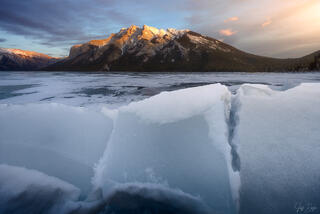
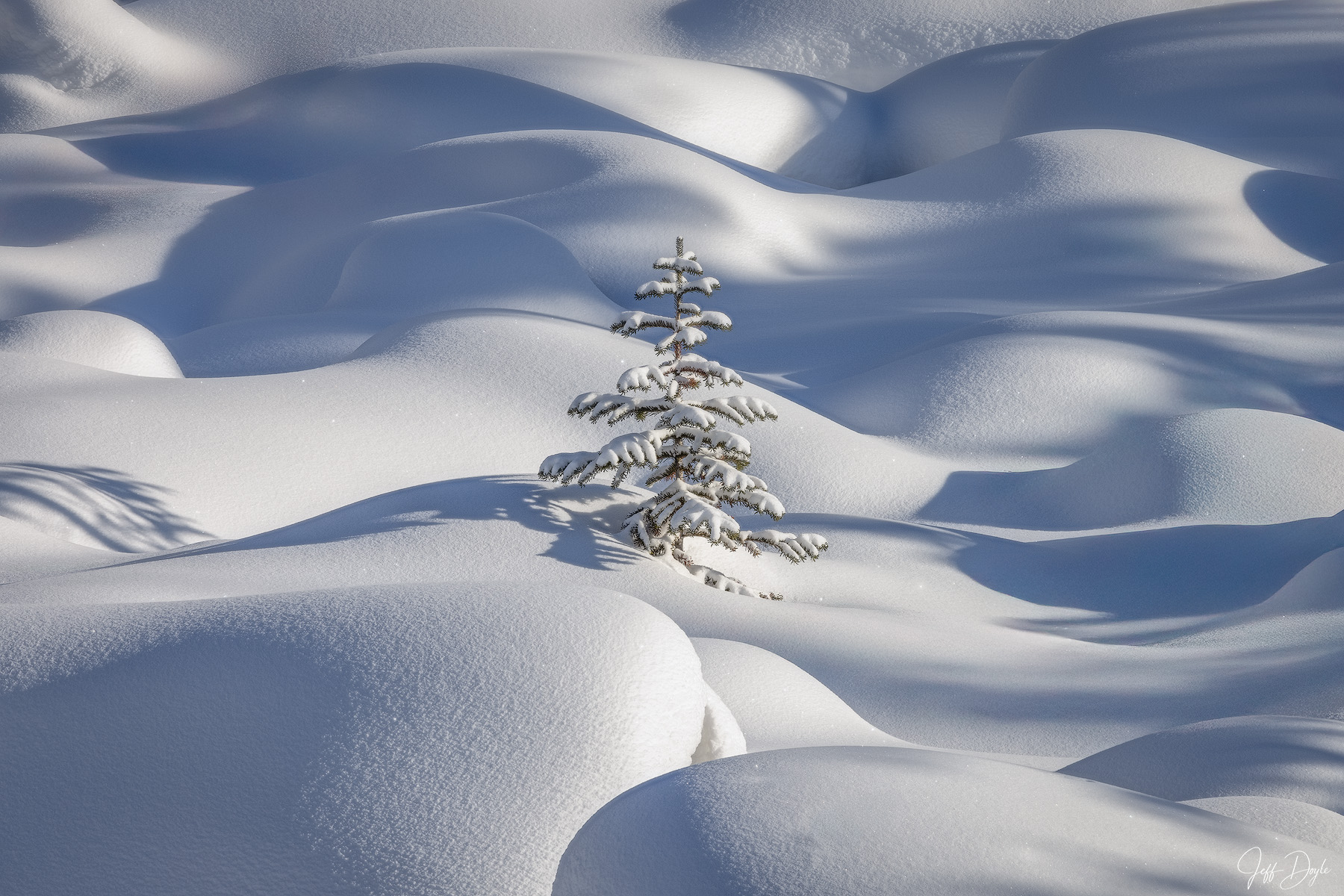
Daniel Tremblay’s Canadian Rockies photographs often combine enormous mountain scenery with carefully chosen foregrounds. Frozen bubbles, fractured ice, and winter textures can become as visually important as the peaks behind them. That relationship between near and far gives the photographs much of their scale.
I’ve spent enough time photographing the Canadian Rockies in winter to appreciate how much work can be hiding behind a finished image like that. Cold changes how long you’re willing to stay in one position. Ice conditions affect where you can work. Light moves quickly through mountain terrain, especially during the short days of winter. Finding a good foreground is only part of the problem. The foreground, mountains, weather, and light still have to come together, and Tremblay manages those relationships repeatedly.

Nick Page
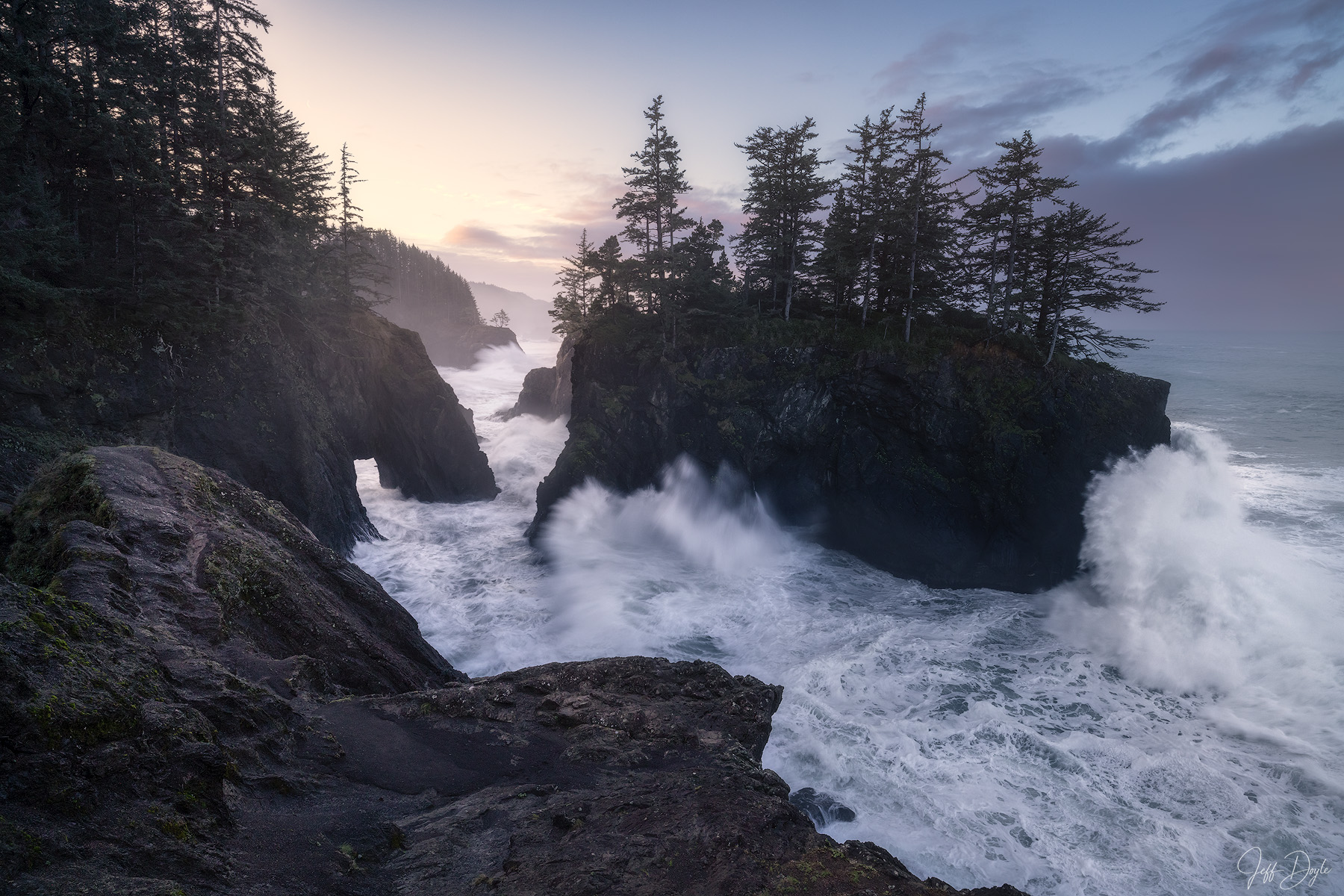
Nick Page is widely known as an educator, but his Oregon Coast photography shows how much of his approach comes from familiarity with place. The coast is constantly changing. Tides alter access and foregrounds. Storm systems move quickly. A promising break in the clouds can close again before you’ve finished setting up.
Returning to the same stretch of coast over and over changes the way you photograph it. You begin to know which compositions need a particular tide. You recognize where light can break through after a storm. You have some idea where to stand when conditions finally line up because you’ve already stood there on the days when they didn’t.
I’ve learned the same lesson photographing the Oregon Coast. A familiar location can produce better work than a new one because you spend less time trying to understand the place and more time paying attention to what is happening.
Scale, Presentation, and the Modern Collector
Contemporary landscape photography also changed on the other side of the camera. Large-format printing became more accessible. New substrates and mounting systems allowed photographs to be produced at sizes that would have been difficult or prohibitively expensive a few decades earlier. Some photographers also built businesses around selling directly to collectors rather than relying entirely on traditional galleries.
Peter Lik and Aaron Reed are useful examples because their influence extends beyond how the photographs themselves look.
Peter Lik
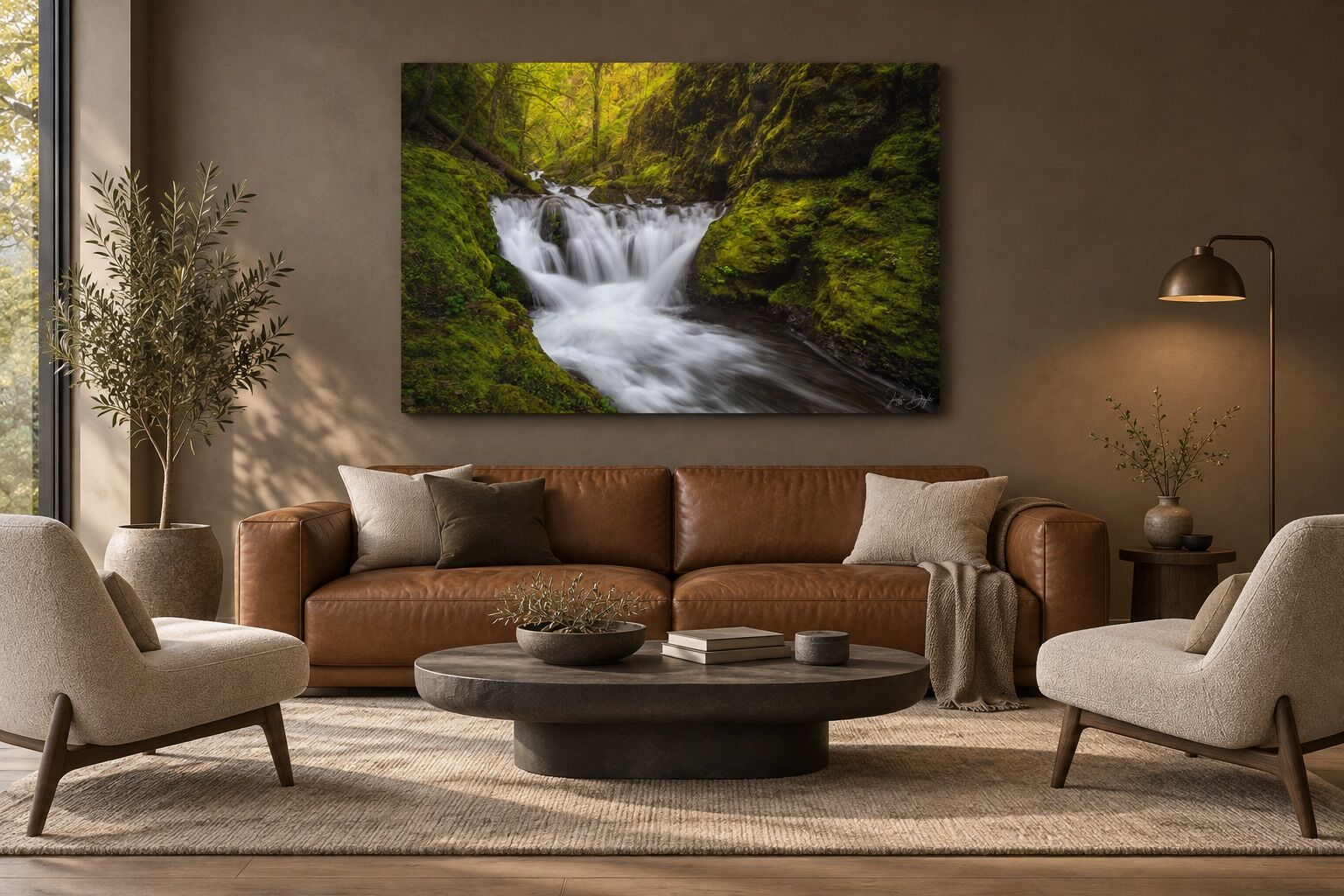
Peter Lik helped introduce a broad audience to landscape photography presented at very large scale. His galleries made the physical presentation of the photograph part of the experience. Large prints, controlled lighting, polished presentation, and highly recognizable landscape subjects created an environment that felt very different from looking at a small photograph in a book or on a screen.
Whatever someone thinks of the aesthetic, that approach demonstrated the power of scale. A photograph changes when it becomes large enough to occupy a substantial part of a wall. Details that disappear on a computer screen become visible, and the relationship between the viewer and the image becomes more physical.
That idea now feels familiar in the fine art landscape market, but it has played an important role in how contemporary photography reaches buyers.
Aaron Reed
Aaron Reed represents another part of the modern landscape photography market: the direct relationship between photographer and collector.
His photographs often emphasize dramatic natural light, strong color, and landscapes with enough visual presence to work at substantial print sizes. The presentation of the finished work is closely connected to the way the photography is positioned.
Artist-direct selling also changes the collector experience. The buyer can learn directly from the photographer about the image, production, presentation, and edition, and that relationship can make the finished print feel more connected to the person who made it.
I’ve always thought that connection matters. A collector who buys directly from a photographer is acquiring the photograph while also gaining some understanding of the decisions and experiences that led to it.
Pattern and a Wider Definition of Landscape
Landscape photography has also become much broader in subject matter.
Mountains, forests, rivers, and coastlines remain central to the genre, but contemporary photographers frequently work with intimate landscapes, aerial patterns, human-altered environments, and photographs that come close to abstraction. Art Wolfe’s career demonstrates how easily those boundaries can expand.
Art Wolfe
Art Wolfe’s work moves through landscape, wildlife, culture, and abstraction, but a strong interest in visual organization connects much of it. Pattern, rhythm, color, and repetition frequently carry as much weight as the identity of the place itself. A photograph may describe a large landscape, or it may isolate a small section until scale becomes difficult to judge.
That raises a question I’ve explored separately in what we actually mean by a landscape. Landscape photography does not require a mountain and a horizon. A stand of trees, an aerial pattern, a section of desert, or a small piece of forest can carry just as much information about place. Modern photographers have pushed that idea further by giving intimate and abstract views equal standing beside the traditional grand landscape. Wolfe’s work fits comfortably across that wider range.
Continuity With the Classical Tradition
Some contemporary photographers feel most modern because of how they use new tools. Others are interesting because they demonstrate how little some of the important parts of landscape photography have changed. Joe Cornish and William Neill both belong in that conversation, though their photographs approach it differently.
Joe Cornish
Joe Cornish’s work retains a strong connection to patient field craft. His landscapes often feel carefully observed rather than hurried. Light clarifies the forms in the landscape instead of overwhelming them, and the compositions frequently reflect a familiarity with place that comes from returning rather than simply arriving.
I appreciate that approach because modern equipment constantly creates the temptation to do more. More exposures. More processing. More detail. More visual intensity. Cornish’s work shows how much can still be accomplished through careful observation, good light, and a strong composition. The modern photographer has access to an enormous technical toolbox, but knowing which tools the photograph actually needs remains part of the craft.
William Neill
William Neill has spent much of his career working in places that are already deeply embedded in the history of landscape photography, particularly Yosemite. His photographs often approach those places indirectly. Motion, softer visual relationships, atmospheric conditions, and intimate compositions can move the viewer away from straightforward description. Instead of presenting only the landmark, the photograph can concentrate on the experience of being there.
That distinction becomes more valuable in locations that have already been photographed countless times. A famous place does not necessarily need another photograph announcing what it looks like. Sometimes the more interesting photograph comes from noticing what the place felt like for a few seconds when weather, movement, or light changed it.
What Defines Modern Landscape Photography?
I don’t think one visual style defines modern landscape photography. The range is far too broad. What does define the period is the number of choices available to the photographer.
Exposure can be literal or blended. Color can be restrained or heavily interpreted. A photographer can work with enormous depth of field or let entire sections of the image disappear into softness. A finished photograph can remain small and quiet or become a wall-sized object. Those possibilities place more responsibility on the photographer. When technical limitations stop making decisions for you, the decisions have to come from somewhere else.
The strongest contemporary landscape photography usually has something deeper holding it together. Sometimes that’s years of familiarity with a particular place. Sometimes it’s an unusually consistent visual language. It may come from patience with weather or from knowing how little information a photograph really needs. Technology continues to change. Those qualities have proven more durable.
What Contemporary Photographers Still Share With the Classical Tradition
It’s easy to focus on how different today’s equipment looks from the cameras used by earlier landscape photographers. The similarities become more obvious in the field.
Photographers still study weather. They still return to places. They still decide what belongs inside the frame and what should be left outside it. They still wait for light and occasionally watch a promising morning collapse into nothing.
The classical national park photographers worked with very different equipment, but they faced the same basic problem. A landscape contains far more information than a photograph can hold. The photographer has to decide which part matters.
Modern cameras haven’t made that decision easier. They’ve simply expanded the ways we can respond to it.

Final Thoughts
The photographers on this list approach landscape photography from very different directions. Marc Adamus and Ryan Dyar demonstrate the range of interpretation possible in the digital era. Michael Kenna shows what repetition and restraint can do. Daniel Tremblay and Nick Page remind me how much field knowledge still matters. Peter Lik and Aaron Reed illustrate how presentation and the direct collector relationship have become part of contemporary landscape photography. Art Wolfe widened the visual boundaries of the genre, while Joe Cornish and William Neill show how older traditions can continue to produce relevant work without being trapped by them.
That variety is one of the things I like most about landscape photography today. The equipment will keep improving. Processing tools will become more powerful. Styles that look current now will eventually begin to show their age.
A good landscape photograph still needs something underneath all of that. It needs attention, decisions, and usually patience. And somewhere in the process, the photographer has to recognize something in the land worth asking another person to spend time with. That’s the part that keeps me returning to it.
If you’re interested in the relationship between photographs and the people who eventually live with them, I’ve written more about why people collect fine art landscape photography. You can also explore my fine art landscape photography and see the places and conditions that have kept me working in the field for more than twenty years.